22/10/2026
Supply chains face increasingly interconnected risks, from geopolitical tensions to natural phenomena. Identifying vulnerabilities, anticipating disruptions, and collaborating with the insurance industry is key to strengthening their resilience.
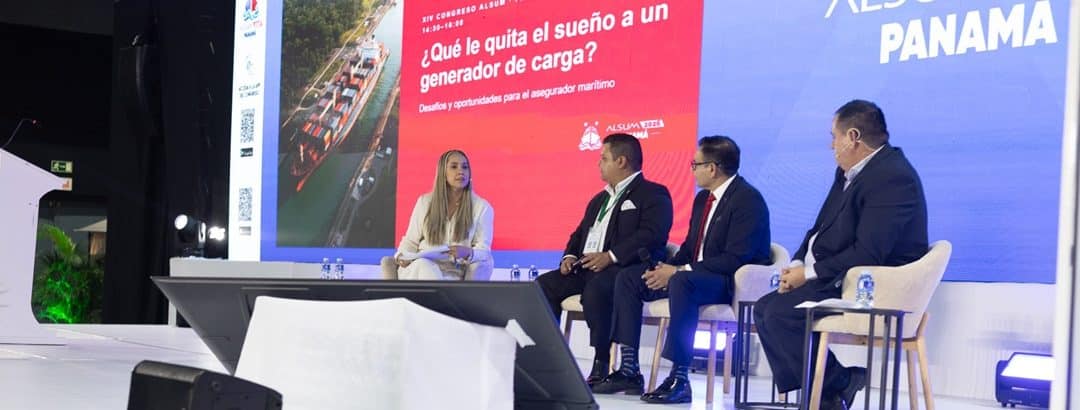
Within the framework of the last Latin American Maritime Insurance Congress of Alsum, held in Panama, the threats looming over the maritime sector were the subject of a conversation about how to face an increasingly uncertain environment. The session focused on the risks that can disrupt international trade, and on how to prepare for the consequences. Beyond reacting when an interruption occurs, the debate raised the need to design more resilient supply chains and strengthen collaboration between operators and the insurance industry to anticipate risks.
What happens when a supply chain breaks?
Inmaculada Pinel, Chairwoman of the Alsum Technical Committee and expert in Transport at Mapfre Global Risks, set down the starting point for the meeting with a question that placed the debate in the realm of decision-making. “When the chain breaks, who makes decisions, with what information and with what support?” This approach started from a premise shared by all the participants: the need to put the customer at the center of the conversation so as to understand the challenges facing those who move goods and thereby come up with the right insurance solutions.
To answer the question, the program addressed the chain from two complementary perspectives: the strategic, focused on network design and unit management; and the operational, dedicated to transport execution, storage, inventories, and the use of technology. The session focused on those factors that companies cannot fully control, but for which they can prepare. The key, as Pinel anticipated, is adaptation.
The chain supervisor needs to be involved in risk management
Jorge Barnett, general manager of the Innovation and Logistics Research Center at Georgia Tech Panama, gave an interesting overview of how the role of the supply chain manager has evolved. Although they are still exclusively linked to operational functions, this profile has been gaining weight in senior management, where they participate in decisions that affect investment, condition customer service levels, and determine the risk exposure of the entire organization. “Chains can’t be fixed, they must be adaptive,” he summarized.
One of its core ideas was that the design of the network depends on the business strategy. A company that competes on speed will need to bring its inventories closer to the consumer and prioritize agility. Another that uses pricing as a competitive advantage will seek economies of scale and continuity in supply. Both decisions have consequences on costs, responsiveness, and assumed risks. It’s also relevant where the inventory is concentrated since, as the expert pointed out, accumulating merchandise in one location means immobilizing capital, but also exposing it to the specific risks of that place.
Barnett identified seven major risk categories: supply, demand, processes, legal and cultural issues, finance, information, and natural phenomena. They don’t act in isolation: a regulatory change can cause social tensions; a provider’s bankruptcy can leave its clients without productive capacity; and a cyberattack can end up paralyzing port, shipping, and ground operations.
Exceptional risks difficult to identify
One of the challenges facing the chain supervisor is to detect vulnerabilities that fall outside of their day-to-day scope of activity. It’s not enough to know the state of a truck or a warehouse: you need to understand what happens in the countries that are traversed, which providers are critical, and how an apparently distant incident can spread through the network. In that context, Barnett pointed out four strategic problems:
- The lack of alignment between business objectives and operations.
- The underutilization of available data.
- The confusion between perception and effective management.
- And the unawareness of risks that the organization believes it has under control.
Information, therefore, isn’t valuable only because of volume, but because of its ability to anticipate scenarios. Supplier monitoring, financial exposure, dependence on certain routes, and cybersecurity must be integrated into a global view of the chain.
One of the pillars of this industry training, according to Barnett, lies in the collaboration with the insurance industry, to which he conveyed several issues that would later be analyzed by experts from the insurance market, namely how to share knowledge about risks that a company can’t observe on its own, and what advantages can a customer gain by investing in resilience and sharing their operational data? Starting from the responses, the objective is to move beyond management that’s focused exclusively on the claim and advance towards preventive collaboration.
More information = better insurance
The subsequent round table, moderated by Valentina Torres, Divisional Director of Gallagher, brought together María Teresa Villegas, Head of Marine at AIG, and Ricardo del Castillo, Head of Reinsurance at Albatroz. During the conversation, they contrasted the needs of companies with the possibilities open to insurers and reinsurers.
Villegas defended the importance of thoroughly understanding the customer’s operation so that underwriting was adequate. Information on routes, stoppages, carriers, safety measures, and high-value cargo treatment enables a better understanding of the risk and designing coverage according to the existing needs.
Concentration in a single port or supplier should not, she explained, be information that the customer hides for fear of automatic penalty. On the contrary: knowing these types of particularities helps the insurer anticipate eventualities and assess the exposure more accurately.
Del Castillo emphasized the need to listen before offering solutions. “We have to improve the quality of this dialog,” he stated, defending a more collaborative relationship between policyholders, brokers, and companies. The market experience is useful, but it doesn’t replace the knowledge that each company has about its own routes, goods, and processes.
Resilience must have value for the customer
Addressing one of Barnett’s concerns, the next question was how to recognize investments in prevention. Villegas was clear: “We can’t treat customers who invest in their operations, who have a reaction plan in the face of any eventuality, who are resilient, and customers who don’t, equally.”
The improved conditions can materialize in aspects such as rates or the deductible applied, although it will depend on the characteristics of each risk. For Torres, from the reinsurance perspective, having information on contingency plans and preparing a company also helps to understand its profile, even when resilience does not translate into a single quantifiable measure.
The session also addressed an important limit: delays and other economic losses resulting from disruptions aren’t automatically covered by a conventional freight transport policy. There are specific solutions for certain economic losses associated with geopolitical events, climate events, or blocking events, but they require a detailed analysis of exposure and their conditions. In conclusion, preventing risk and transferring it are distinct tasks that must be coordinated. Insurance coverage is a piece of resilience, not its substitute.