05/11/2026
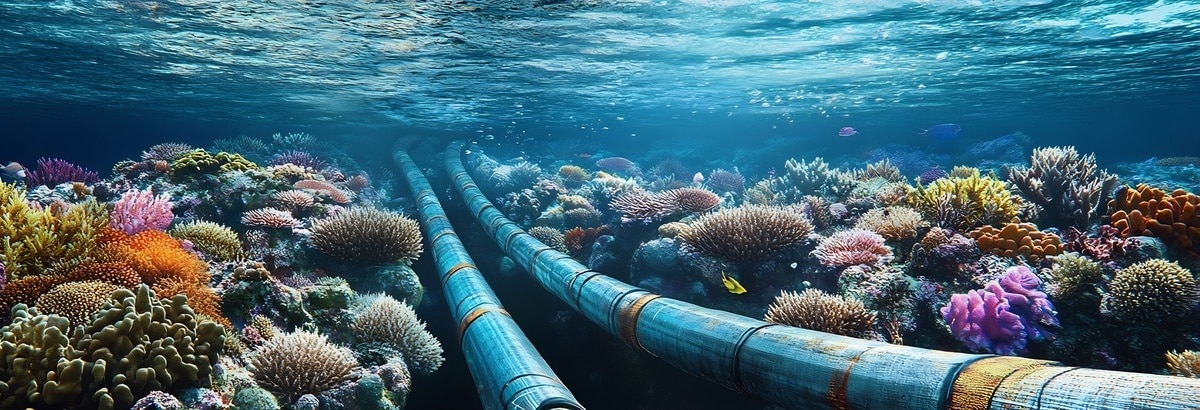
Beneath the oceans lies an infrastructure that is critical to the global economy and global communications: submarine cables. They carry most of the international data traffic and must deal with constant technological, economic, and geopolitical challenges.
In 2022, we analyzed the role of these invisible arteries, which make up the largest telecommunications network in the world, together with Noelia Miranda, Project Manager at the Official College of Telecommunications Engineers (COIT). Four years later, we revisit this topic in a new joint interview with her and María López, Project Technician at COIT, to analyze the evolution of the sector, its strategic importance, and the main challenges it faces.
An invisible but essential network
According to Doreen Bogdan-Martin, general secretary of the International Telecommunication Union (ITU), all the underwater cables installed in the world would go around the Earth between 30 and 40 times. These infrastructures also carry around 99% of international Internet traffic.
The increase in the number of connected devices, the digitalization of the economy, and the growing volume of data that we generate and share require infrastructures that are capable of conveying information increasingly, faster and with less latency. The need to respond to this demand is driving investment and encouraging the entry of new players in the sector.
Alongside traditional telecommunications companies, large technology companies such as Google, Amazon, and Meta have gained prominence in the development of submarine cables. Their investment capacity allows them to undertake large-scale projects and reduce their dependence on third parties to access networks and distribute their content.
Among the ongoing projects, Waterworth, driven by Meta, stands out, in that it involves the deployment of 50,000 kilometers of cable to connect five continents, with a route designed to avoid vulnerable areas such as the Suez Canal or the Strait of Malaca, as does, Medusa, promoted by AFR-IX Telecom and Orange and supported by European Union funding. With a planned investment of 342 million euros, this system will connect five European countries with four African countries across the Mediterranean.
Geopolitics and security
Miranda and López highlight that submarine cables have acquired an increasingly relevant geopolitical dimension. By carrying a large part of the world’s information, they have become strategic infrastructures for national security. Tensions between the United States, China, and Russia have placed control of these networks and the planning of their routes at the center of international concerns.
Decisions about the routes also respond to political considerations and security considerations. An example is the restrictions imposed by the United States on the authorization of certain cables that connect to its territory when their routes pass through Hong Kong or involve Chinese companies. These limitations have contributed to redirecting some investments towards other Asian connectivity centers, such as Singapore, the Philippines, and Japan.
Route planning is also conditioned by regulatory requirements. The installation of a cable requires obtaining relevant permits in the countries where its mooring points are located and complying with the applicable regulations in the territorial waters and exclusive economic zones through which it passes. Therefore, as the interviewees explain, some projects seek to avoid certain areas, such as the South China Sea or the Red Sea, with the aim of reducing operational risks and difficulties associated with authorizations.
Added to these issues is the physical vulnerability of the networks, which can suffer accidental or intentional damage. At the end of 2024, several cables from northern Europe were damaged in incidents where the possible involvement of vessels dragging their anchors was investigated. Although it has not been conclusively demonstrated that these episodes were deliberate attacks, they raised significant concerns about communications security. In 2025, the European Union announced a plan to strengthen the protection of these infrastructures. Likewise, the instability associated with the conflict in Gaza has made it difficult to maintain and repair certain cables, which has forced the adaptation of certain operations and routes.
Risk management: maintenance and protection
Among the main threats to submarine cables are cuts caused by fishing activities and anchor dragging, natural phenomena, possible damage resulting from interaction with the marine environment, and deliberate human actions. Determining the origin of a fault isn’t always easy and largely depends on the circumstances and the location where it occurs. Therefore, having specialized means to locate damages and repair connections in the shortest possible time is essential to ensure service continuity, and there are fleets of ships prepared to intervene when an incident is detected.
Prevention also comes on the back of advances made in technologies that are capable of detecting anomalies before a breakdown occurs. One of them is distributed acoustic detection, which uses fiber optics as a sensor to identify vibrations along the cable. This technology can detect signals associated with upcoming activities, such as chain movement or anchor drag.
Another option is automatic ship identification, which provides information on its position and movements. Combining both sources of information with data on the location of cables allows identifying patterns of activity that deserve special attention, such as prolonged delays or changes in the course of a vessel near a sensitive area. These signals alone don’t demonstrate illicit behavior, but they can contribute to improving risk monitoring and risk assessment.
The experts also highlight the measures taken by different countries to strengthen the protection of these infrastructures. France employs autonomous submarine vehicles and vehicles operated by remote control to inspect the seabed. The Nordic countries have intensified surveillance after several incidents in the Baltic Sea. Norway and Denmark have strengthened their underwater monitoring capabilities, while Finland has expanded the powers of its authorities to inspect activities close to the cables. Australia, for its part, has established protection zones around certain submarine cables, in which activities such as bottom fishing and dredging are restricted. The failure to comply with the applicable provisions may entail criminal sanctions, the severity of which depends on the violation and the corresponding legislation.
Data centers, AI and new challenges
The growth in data volume and the expansion of data centers are increasing the demands placed on the world’s underwater networks. The global volume of data created, captured, copied, and consumed has seen exponential growth, driven by video streaming, social media, videogames, cloud services, teleworking, and generative artificial intelligence. More than 99% of intercontinental data travels through submarine fiber optic cables, which have evolved from being telephone ducts to integrating into the architectures of data centers of large companies like Meta and Google. Its expansion requires global mesh networks that are resilient and have very low latency to ensure data exchange between regions.
Video-on-demand and live-streamed video account for between 60% and 65% of Internet data volume. Video games also contribute to this demand: online gaming requires low latency to ensure a smooth experience, while the digital distribution of movies and TV shows—with downloads that can reach 50 to 150 GB—increases the capacity requirements of networks. The traffic associated with these services is in addition to that generated by language models and the synchronization of data centers distributed across continents. In this context, transmission capacity, speed, and low latency remain fundamental requirements.
New routes and challenges for the future
The concentration of cables in strategic points, such as the Luzon Strait and around the Suez Canal, increases the exposure of networks to risks like damage caused by anchors, marine incidents, earthquakes, and geopolitical tensions. This vulnerability is driving interest in diversifying routes and developing alternative routes that reduce dependence on certain brokers. Among them are projects such as 2Africa, by Meta, and less traditional maritime corridors in the South Pacific or the Arctic, like Polar Express, owned by Russia.
Miranda and López identify several challenges for the future of the sector. Among them are regulatory barriers, which can hinder investment and widen digital, economic, and social gaps; the physical protection of networks and their resilience in conflict zones and complex submarine environments; reducing the environmental impact of deployments; and the limited availability of specialized vessels to install and repair cables.
The evolution of these infrastructures will therefore depend on the ability to respond to increased demand and to guarantee the security, resilience, and continuity of essential networks for the digital economy and international relations.
Article collaborators
 Noelia MirandaNoelia Miranda is a Telecommunications Engineer graduate of the Polytechnic University of Madrid, and is head of Projects at the Official Association of Telecommunications Engineers (CILO). Her professional experience focuses on the study of technological solutions used in telecommunications and the economic and regulatory policy aspects of telecommunications. She has participated and co-authored as a representative of the COIT publications, articles, and presentations in journals, conferences, and congresses. She has specific training in project management and coordination, also highlighting the development of new services and the diagnosis and prospecting of new professional opportunities for the Telecommunications Engineer.
 María LópezMaría López is a graduate in Telecommunications Technologies from Carlos III University of Madrid and is currently pursuing a master’s degree in Telecommunications Engineering at the same university. She works as a Project Technician at the Official Association of Telecommunications Engineers (CILO), where she collaborates on projects in the field of telecommunications, performing research and technical analysis tasks. Within the framework of his activity at COIT, she has collaborated in the preparation of this article on submarine cables. She also has international academic experience in the United States and France.