03/11/2026
As well as protecting their goods against damage, freight forwarding companies need to ensure that they can continue with their commerical activity when the unexpected happens. Understanding the risks they face and adapting coverages to operational realities is one of the major challenges of maritime insurance.
Within the framework of the latest Alsum Latin American Maritime Insurance Congress, held in Panama, representatives from the world of logistics and insurance experts discussed the main concerns surrounding freight forwarding and opportunities to strengthen collaboration with the insurance industry.
The policy covers the load, but the business needs continuity
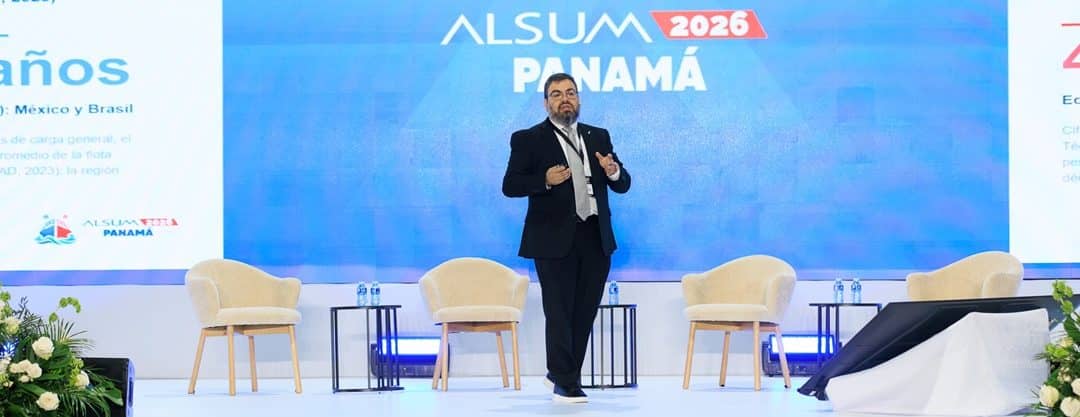
Luis Guillermo Gómez, Supply Chain vice president at Empresa Panameña de Alimentos (EPA), began by presenting the point of view of someone who has to ensure the daily operation of a company in the face of unexpected events. And here a divergence of intentions arises. According to his approach, while the insurer asks what happened to the goods, the operations manager worries about business continuity. Cargo can arrive intact and be late at the same time. During the delay, the company may face a production stoppage, resort to extraordinary purchases, incur higher transportation costs, suffer stock breaks, or lose customers.
“The problem isn’t necessarily the merchandise itself,” Gómez insisted, explaining that the financial impact of a business interruption can far exceed its insured value. The damages don’t end when the cargo is recovered: it can also compromise the reputation and competitive position of the company. For this expert, risk management begins long before the claimable event occurs. It consists of identifying vulnerabilities, determining when a problem should be addressed, and having sufficient protection in place to prevent an incident from reaching the consumer.
According to their experience with EPA, the challenge is even greater in Panama, whose presence as an international logistics platform runs parallel to a high dependence on imported raw materials and significant exposure to external factors. Changes in maritime routes, port limitations, water availability on the canal, customs problems, or land blockades can impact the entire chain.
And now, technology has added a new risk factor on top. Warehouse management systems, transport planning, and freight tracking systems provide visibility and efficiency, but they also create new dependencies. When a technology platform is required to move a load, a computer incident can physically paralyze the entire operation.
From cargo insurance to corporate resilience
One of the shortcomings pointed out by Gómez in the relationship between companies with logistics activities and the insurance industry is that protection usually focuses on the goods, when the real need is to find solutions that also consider the resilience of the business. To this end, he proposes studying the damages derived from certain events without effective physical damage, analyzing specific coverage for delays, and designing products linked to specific vulnerabilities, such as a critical provider, a port, or a specific route.
Instead of focusing on the cargo or the transport vehicle, the analysis should center on defining other losses or damages that can be insured, accrediting the economic consequences susceptible to coverage. Gómez is looking for ways to achieve corporate resilience and focus investment on it: having alternative providers on standby, testing different shipping routes, or maintaining continuity plans involves a cost that insurance conditions should consider.
Gómez also pointed out the distance between those who negotiate policies and those who have to apply them during an emergency. “I find out what the policy covered or didn’t cover after the claimable event has happened,” he said when describing a situation that can generate surprises when it’s already too late to correct them. His message to the sector was clear: “I don’t want to collect on an insurance policy – I want to run my business.” As a logistics supervisor, he recognizes that his priority is to his operation back on track, not to process compensation.
The operators’ viewpoint
After Luis’s presentation, Julio César Balderas, representative of the National Chamber of the Tequila Industry of Mexico, and Danilo Bustamante, president of COEL in Panama, joined the debate, and with their experiences, expanded on Luis Guillermo’s diagnosis.
Balderas identified the increase in road insecurity as one of the main threats to the tequila industry. The rise in violence has forced the strengthening of surveillance and coordination with carriers, authorities, and other companies. During a road closure, his organization resorted to using motorcycles to transport tax stamps (the labels that give legal standing to the alcoholic product and which are necessary to market and distribute it). “We don’t protect a bottle of tequila, we protect Mexico,” he stated, explaining the implication and importance of a drink that’s an essential part of the country’s identity.
Bustamante, for his part, highlighted uncertainty as a constant in the logistics environment. Changes in routes, tariffs, and consumption patterns require adapting operations, while infrastructure concentration can amplify the impact of a blockade. “The new constant in the world is uncertainty,” he summarized. In the face of these challenges, he advocated for greater collaboration among companies, industry associations, and public administrations.
Both participants agreed on the importance of coordination and trust and concurred with his counterpart from the EPA that there is an opportunity for insurers to participate in prevention and the design of risk plans, rather than stepping up only after a claim is filed.
The insurers’ viewpoint
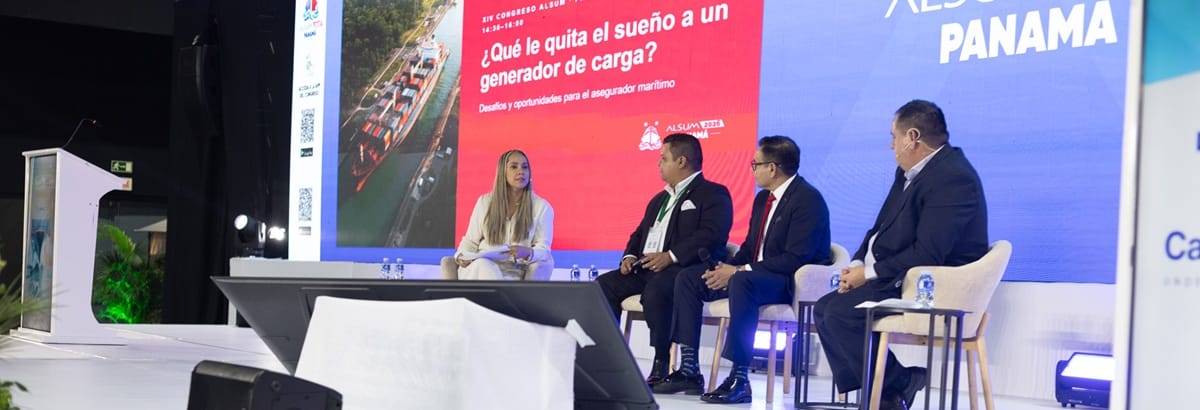
In the final stretch of this interesting presentation, moderated by Gabriel Villalobos (Alsum), Maricarmen de Serracín, a consultant, Carlos Leymarie from Assistcargo Risk Management, and Esaú Mendoza from Keeper, addressed how the needs presented by the sector could be translated into concrete solutions. De Serracín recalled that the protection of merchandise and business continuity may involve different coverages and responsibilities, but that this technical separation shouldn’t give rise to a fragmented customer experience. “They are two completely different fields, but sometimes we as underwriters make the mistake of pigeonholing ourselves,” he acknowledged. To avoid this, it’s essential to know the complete operation in depth, review the contractual conditions, and bridge protection gaps that are identified.
Mendoza, for his part, recognized the responsibility of brokers and the need for the sector to understand logistical language, instead of expecting operations managers to master the language of insurance. He also emphasized that events must be objectively measurable, and with this goal in mind, he proposed four elements to consider: time, location, event, and consequence. Leymarie focused his contribution on information. Business management tools, transportation planning, route optimization, and logistical visibility can help better understand each customer’s exposure. Risk analysis, security protocols, and continuity and crisis response plans must also be included.
One of the shared conclusions was that taking out insurance shouldn’t depend exclusively on price criteria or isolated decisions of the finance department. The logistics area, operations, security, and risks areas need to participate in the negotiation to ensure that the agreed conditions reflect the real needs of the company. Technology could facilitate more accurate underwriting, but it needs to be accompanied by knowledge, communication, and monitoring.