16/04/2026
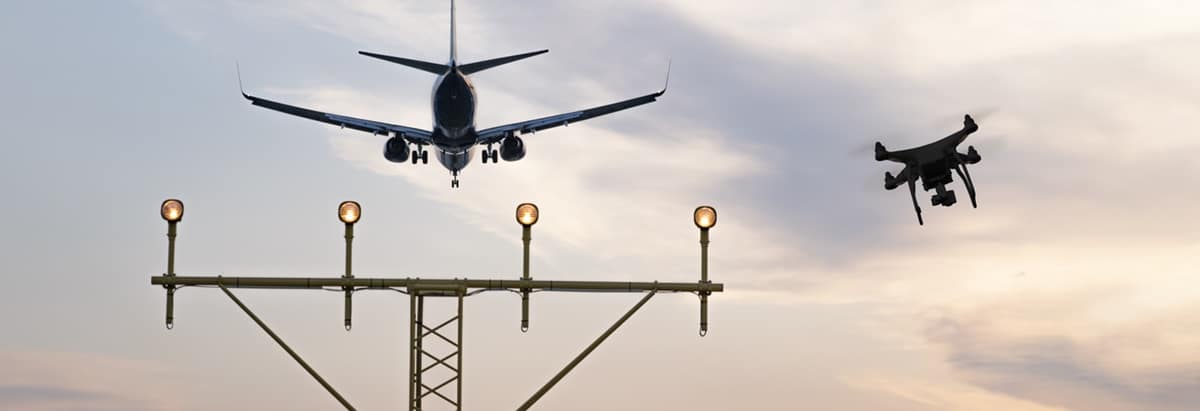
The integration of drones into conventional air space seems imminent, but it poses operational challenges and safety challenges. Virginia R. Martín (U-space Operations Development Division of ENAIRE, the air navigation manager in Spain, certified for the provision of en route, approach and aerodrome control services.) analyzes the challenges of integrating manned and unmanned flights.
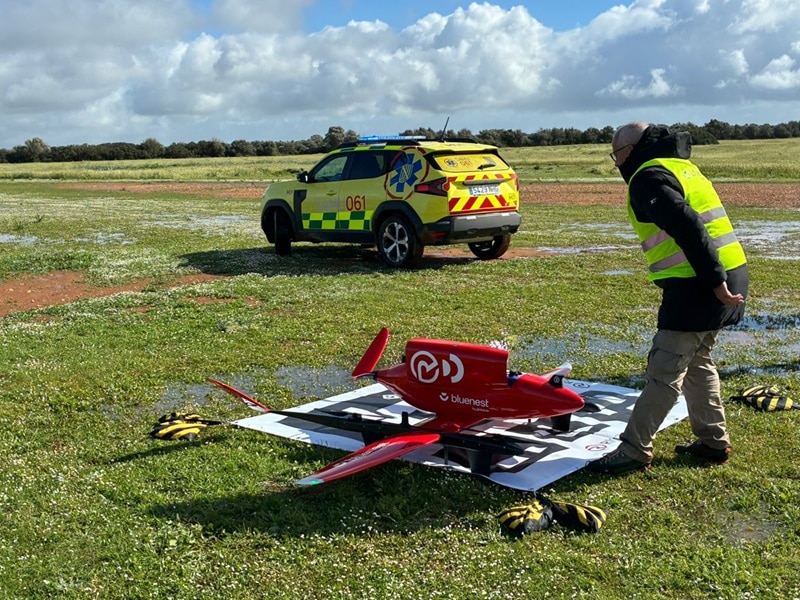
Traditional aviation is going through a technological transformation that poses a complex challenge related to how to integrate innovations such as drones and electric vertical take-off and vertical landing (eVTOL) craft in a sector where safety and regulation are strictly enforce. To ensure that these new technologies can coexist with manned flights without compromising safety and efficiency, different tests are being conducted. As part of the Eureka Project, a trial has been conducted at Palma de Mallorca Airport, where a drone transported medical supplies to the Son Albertí airfield.
Virginia R. Martín, a member of the Development Division of Operation U-Space at ENAIRE, details in this interview how the systems and protocols necessary for drones and manned aircraft to share air space safely are being developed.
What specific applications can drones and other unmanned aircraft have in the environment of a commercial airport?
Drones and unmanned aircraft as means of transportation are still in the development phase. Initially, the practical applications are focused on emergencies like health tasks. With the consolidation of operations, there is a huge field that’s already being explored for logistics, maintenance, and inspection, supported by industrial activity around the airports. A purely airport-related example is runway inspections with drones. Then there are “last mile” deliveries or passenger transport (the so-called “air taxis”). It’s expected, therefore, that drones and other novel types of aircraft, framed within the so-called innovative air mobility (IAM), will increase connectivity options, using more efficient and sustainable means of transport.
From an operational standpoint, what changes happen in air traffic management when drones and, in the future, eVTOL craft are incorporated into conventional airspace?
In the event of any changes to the airspace, it’s essential to ensure the compatibility of all operations, so that the level of safety of each one is not affected by others. This involves designing new flight procedures and rules that allow for the coexistence of drones and manned aircraft in the airspace, as well as basic training for the personnel involved.
Are all airports in a position to integrate this type of operation, or must certain technical, operational requirements or traffic volume be met?
There are common standards and common needs that would be replicable at all airports, but each infrastructure has its own particularities and we need to study each case, especially at the beginning. Also, it’s expected that traffic demand will be higher at airports with a high volume of passengers, where, due to their complexity, the technical conditions may be more demanding.
What information is critical for an operation with drones at an airport to avoid interference and conflicts with manned aviation?
Coordination is a key concept in the developments being carried out by ENAIRE, in collaboration with Aena, relevant authorities, and operators. It’s essential to be aware of the position of each airspace user, and other operational parameters, so that they don’t interfere with each other during the flight. To achieve this, the information flows between those involved need to be defined and operate fluently and reliably. In this sense, the architecture being developed will facilitate the links so that these information exchanges are optimal.
ENAIRE will assume the role of common information provider in the U-space environment in Spain. What does this responsibility entail, and what technical and operational challenges does it involve?
The greatest difficulty is to develop and implement an entirely new system from scratch. Put simply, we’re starting with a blank page. Technically, it’s a complex software development, in which highly digitized and automated management are prioritized, capable of servicing a large number of drones. Security, in all its aspects, will take center stage in the operational phase, at which point ENAIRE’s operational experience will be an enabler.
What technologies and digital systems are essential to ensuring the safe operation of drones and future electric aircraft in complex airport environments?
In complex airport environments, it’s essential for all users “to see and be seen.” This is achieved by using devices that allow for knowing the position and other data of the drone and sending the information via an Internet connection. These systems, along with the aircraft surveillance systems (with radar being the most well-known), provide a complete picture of air traffic in a certain area.
As far as U-space goes, the common information and service providers (known as CISP and USSP) will provide a series of mandatory tools that facilitate operations through their respective digital platforms (flight plan management, traffic information, etc.). Finally, U-space requires that manned aircraft be equipped with e-conspicuity technologies, also dedicated to determining their position.
In an ecosystem with multiple actors – operators, U-space providers, airport managers, and authorities – what are the main risks you can identify today? Are they in technology, in coordination, or in the possible interdependence between systems?
Although the technology already exists, we’re talking about complex systems and considerable economic scope, which are typical features in innovation. So I’d highlight the coordination among those multiple actors that you mention. In Spain, work is being done, together with the Directorate General of Civil Aviation and the Spanish Aviation Safety Agency on a centralized architecture that facilitates that coordination. I’d also mention the aspect of financial return, due to the high cost of innovative deployments. Both aspects are key for us all to be able to get the most out of this new air mobility as a society.
If a technological or digital failure occurred on the platform that supports these operations, what impact would it have and how is service continuity guaranteed?
The aeronautical professions, particularly those related to air navigation, are concerned first and foremost with safety. At ENAIRE we say that safety is embedded in our DNA. That’s why before any system is put into service, whether it’s new or evolutionary, all the possibilities and permutations are studied in great detail. As such, depending on each eventuality, different mitigation strategies are planned, with the aim of always ensuring the highest safety standards.
From a regulatory perspective, do you think that Europe, through bodies like the European Union Aviation Safety Agency, is advancing at the same pace as technological evolution?
It’s an interesting question. The guarantees that Europe requires for any initiative with socio-economic repercussions ensure that the regulations are developed with high safety standards in mind. Focusing on innovation technologies, which by their nature require additional effort in their implementation, it’s essential to conduct validation tests and reach an agreement among many players. In this regard, it’s important that institutions and industry move forward hand in hand so as to combine both aspects efficiently.
Looking ahead to the medium term, what’s the biggest challenge for vertiports and U-space to establish themselves as a safe, scalable, and economically viable operational reality?
In my opinion, the challenge lies in executing a gradual development of increasingly complex, sustainable operations that we can learn from. As part of this process, new services will be incorporated, already in development in R&D+i projects. For this to be a reality, institutional support is essential, and is continuing to work together, with each integral part of the sector contributing their strengths, interests, and ideas.
Article collaborators

Virginia R. Martín studied aeronautics at the Polytechnic University of Madrid and has a degree in Business Administration and Management from UNED. She has more than 20 years of professional experience at Aena and ENAIRE, working in the fields of airport management and air navigation. She currently participates in the development of business and services for drones, from the Development Division of Operation U-space of ENAIRE.