13/05/2026
At times, the immediacy of a news item and the urgency to broadcast it mean that after the initial impact has subsided, an unrelated succession of data and opinions remain. On this occasion, we want to pause, take a step back, and analyze an event that generated an enormous impact in the media from an objective perspective.
In this article, we’ll address the eruption of the Tajogaite volcano, which occurred in La Palma in 2021, an event that dominated headlines and live broadcasts for months. To understand what really happened and the volcanic risk that exists, we spoke to Pablo J. González, scientific researcher and head of the Department of Life and Earth Sciences at the Institute of Natural Products and Agrobiology (IPNA-CSIC) in San Cristóbal de La Laguna, on the island of Tenerife.
A very real, very localized, risk
Volcanic risk in Spain is real, but geographically very uneven. It’s concentrated almost entirely in the Canary Islands, where four islands —Tenerife, La Palma, El Hierro, and Lanzarote— are deemed high risk in terms of eruptions. However, volcanic risk in Tenerife is one of the highest in the world, due to its larger economy and population. In this geological context, the eruption of Tajogaite in 2021 wasn’t exceptional, given that historical records indicate that the Canary Islands are exposed to an eruption every four decades, on average.
The classification of volcanoes by activity is still under debate, but current scientific consensus considers those with eruptions within the last 11,700 years as active. Following this criterion, the almost all of Spain’s active volcanoes are to be found in the Canary Islands. Among them, the central volcanic complex and the three ridges of Tenerife, the Cumbre Vieja ridge in La Palma, as well as the volcanic systems of El Hierro and Lanzarote stand out. La Gomera can now be considered extinct from a volcanic perspective.
There is also a relevant volcanic territory to be found on the Iberian Peninsula, namely the monogenetic field of La Garrotxa in northeastern Catalonia, Spain, whose eruptive history is comparable to that of some Canary Islands with less recent activity. Tallying the number of volcanoes in Spain depends on which definition is used, but the significant eruptive potential is definitely concentrated in the Canary Islands.
This dominant eruptive style coexists in Tenerife with the less frequent activity of the central volcanic system of Teide-Pico Viejo, which could produce more energy-efficient explosive events, although they are less likely.
Types of eruption and their effect
In Spain, Strombolian-type eruptions dominate, characterized by the emission of lava flows, pyroclasts, and moderate explosive episodes. These eruptions generate fields covered by solid lava, accumulations of volcanic pumps, and ash deposits.
Bomb-like falls with ballistic trajectories can occur near the eruptive centers, while emissions of gases like sulfur dioxide (SO₂) or carbon dioxide (CO₂) are also recorded. In some cases, phreatomagmatic phases may appear (when magma comes into contact with water) generating finer ash and greater explosiveness.
The impact on people can be ranked by severity. The most severe, although infrequent, is the destruction of homes due to advancing lava flows. The most common are temporary effects from gases and ash, which affect mobility, respiratory health, and daily life. On top of this is the psychologic impact derived from seismicity and explosions, the vibrations of which are felt by wide sections of the population, provoking much anxiety, even when there’s no structural danger. To deal with these risks, authorities must have regional plans in place that include housing, mobility, water and energy transportation infrastructure, and telecommunications networks, not to mention relocating tourists.
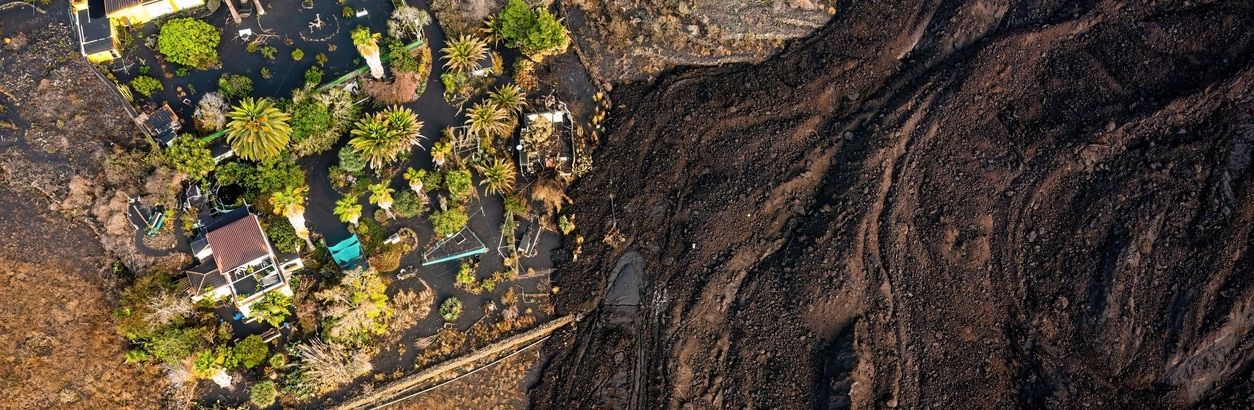
The eruption of La Palma demonstrated the importance of ashfall – tiny, jagged particles of rock and natural glass blasted into the air by a volcano – because it expands the geographic range of the impact of the eruption. It degrades air quality, affects health, and compromises the economic continuity of numerous services and businesses. A volcanic eruption is, essentially, a social shock. When the emergency lasts for weeks or months, its effects deepen and become more complex to manage, both on a material and emotional level.
The most devastating impact is the total loss of homes due to the advance of the lava flows, a slow and distressing process that creates great uncertainty. Modern volcanology can quite accurately delineate the maximum flood zones by using the location of vents and topographical information, but the duration of the eruption and the volume it emits remain very uncertain variables. These two factors really control when and how far the lava will advance, and for that reason, it’s still difficult to accurately predict the pace of progress.
Volcanic monitoring, emergency management, and prediction limits
In Spain, volcanic monitoring and alerts are the responsibility of the National Geographic Institute (IGN). Its monitoring systems are multiparametric and include seismic networks, control systems for terrain deformation, and geochemical sampling in gases or groundwater. The continuous monitoring of these parameters, along with data on past eruptions, allows for the recognition and interpretation of precursor patterns of volcanic activity.
The Canary Islands government has an emergency plan known as the Special Plan for Civil Protection and Emergency Response for Volcanic Risk in the Canary Islands (PEVOLCA) in place to deal with volcanic eruptions, which encompasses scientific advice, civil protection and local authority decision-making. Its activation implies the deployment of measures including informing the public, preparing evacuation routes, protecting infrastructure, and shelter and social care logistics. During the eruptive phase, safety perimeters are applied, air quality is measured, and staggered access to evacuated areas is implemented.
But what degree of anticipation can science currently offer, and what limitations exist? Predicting eruptions remains an uncertain business. Recent studies indicate that, even with very dense surveillance networks, the success rate rarely exceeds 50%. This suggests that the main limitation isn’t only in the tools and instruments available to us, but in our incomplete understanding of the eruptive process itself. Moving forward involves more than maintaining current networks – we need to invest much more in research personnel, in their ability to conduct experiments, and in basic science that allows us to understand why a volcanic system erupts when it does. Without that knowledge, it’s hard to move the needle on predictive capacity.
Territorial planning and preventive culture
The key lies in territorial planning and planning that reduce exposure:
- Avoid devloping urban centers in high danger areas
- Locate residential and industrial developments outside of these areas
- Incorporate resilience and redundancy criteria into the design of critical services
This is difficult to do in the Canary Islands because of its very dispersed occupation model, which increases vulnerability and risk.
It also doesn’t help that detailed geological studies to improve hazard maps are not considered a priority. Today, investment is mainly geared toward instrument networks and emergency plans, but knowledge about possible and probable eruptive scenarios, derived from the study of past eruptions, remains very limited. This lack of baseline affects the actual effectiveness of the evacuation routes, the protocols in place for vulnerable people, and the operational continuity of many services.
After the 2021 eruption in La Palma, some progress has been made. In the Canary Islands, the population is more aware of the volcanic traffic light alerts and the effects of gases and ashes, and technical coordination within PEVOLCA has improved. However, there’s still a long way to go in terms of consolidating a preventive culture.
Among the necessary measures are integrating hazard maps updates into urban planning, boosting education on geological risks in schools, standardizing alert messages, and conducting periodic simulations, like the one carried out in Garachico in Tenerife in September 2025. In addition, there’s a need to strengthen economic resilience via insurance, the registration of properties to facilitate future aid, and better-planned reconstruction.
Spain is reasonably well prepared as far as surveillance and response go, especially in the Canary Islands, but the next step is to strengthen investment in science and knowledge so we can move toward a more effective anticipation of volcanic risk.
Article collaborators:
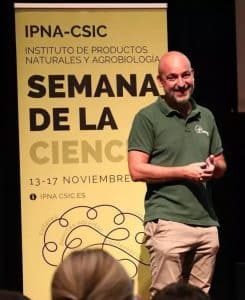
Pablo J. González (La Orotava, 1978) is a scientific researcher and head of the Department of Life and Earth Sciences of the IPNA-CSIC, in La Laguna, Tenerife. Since 2022, he has been directing the Volcanological Station of the Canary Islands, the longest-standing volcanology research group in the Canary Islands, initiated in 1983. Dr. González represents CSIC on the PEVOLCA scientific advisory committee.
With more than 20 years of experience, he has published over 75 international scientific articles, including works in journals such as Science, Nature, and Nature Geoscience, and has edited three specialist books on volcanology and geodynamics. In 2020, he was awarded a Leonardo grant from the BBVA Foundation, which recognizes researchers and creators under 45 years old with outstanding trajectories. His research focuses on the internal dynamics of volcanoes and the improvement of volcanic surveillance systems, and he has made significant contributions in the wake of the recent eruptions of El Hierro and La Palma.