29/05/2026
Friday, May 29
The second session of the Mapfre International Global Risks Seminar brought together experts to discuss global geostrategy—across both politics and economics—as well as key sectors shaping an increasingly complex and challenging business landscape.
Roundtable discussion: “Electrification, global geopolitics, and the energy transition: challenges and opportunities for insurance”
These three closely connected themes were the focus of the day’s first roundtable discussion, moderated by Alberto Mengotti, Director of Underwriting for the Energy Area at Mapfre Global Risks. He was joined by Orlando García, Corporate Head of Loss Prevention at ENGIE, and Ramón Presa, Upstream and Downstream Insurance Manager at Repsol, for a thoughtful conversation about the major risks and opportunities facing the sector, and on how insurance can help support this transition.
Electrification has become one of the great challenges of the energy transition, although, as Orlando García noted, each challenge has also opened up new opportunities. For his part, Ramón Presa explained that Repsol has embarked on a “profound transformation process” in recent years, building on its identity as an oil company. In this process, as in other lines of business, the insurance industry plays an enabling role. “Mapfre is a great example of this,” he said. “It’s a long-term partner that stands by us through good times and bad and provides us with capacity across nearly all lines.”
Repsol’s insurance manager acknowledged that risk runs through the entire oil value chain, from production to supply. He also noted that 35 refineries have closed across Europe in recent years, although he stressed that “fortunately, in Spain, companies like Repsol decided to swim against the tide… and made a decisive commitment to investing in refining… I dare say we’re not going to face the supply problems that other European countries may suffer… because we’ve done our homework.”
The conversation also addressed the impact of global geopolitics and the risks arising from growing international instability. From Repsol’s perspective, Ramón Presa warned of the strong dependence on China, both for the supply of materials and for the technological development linked to the energy transition.
Orlando García, meanwhile, emphasized that in a context marked by recent incidents and high uncertainty, people’s safety must remain the absolute priority. He also pointed to a degree of inconsistency in financial markets in response to these events and said a correction is likely, one that companies need to be prepared for. Speaking from ENGIE’s perspective, he also called for greater flexibility from insurers, as well as ongoing communication, arguing that the sector can become an essential ally thanks to its expertise and its ability to support business development and knowledge sharing. “These discussions are a great example of that,” he emphasized.
Repsol echoed this view: “The sector can help us better understand risks and, for that reason, it should be brought into projects as early as possible and play a supporting role in improving their bankability.”
Engineering talk: “Remote sensing for thermal anomaly detection”
The session, moderated by Óscar Estrada, Deputy Director of Intelligence at Mapfre Global Risks, and delivered by Carlos Bernabéu, CEO of Arbórea Intellbird, was one of the most dynamic and engaging presentations of the seminar. The session showcased advanced thermal sensing technology for risk detection, highlighting both how it works and its practical applications across different industrial and risk prevention environments.
The speakers explained how these tools enable the early identification of thermal anomalies, helping reduce risk exposure and prevent hazards before they escalate. The audience also saw a live demonstration of a device capable of analyzing heat signatures from attendees and machinery at the venue, generating significant interest among participants.
Carlos Bernabéu emphasized the importance of this technology, stating that “our goal is to reduce strain and minimize risks that would otherwise be difficult to absorb.” As a practical example, he highlighted the use of smart brush-cutting equipment at large solar farms. These devices are capable not only of clearing vegetation, but also of detecting temperature changes, analyzing potential incidents, and issuing alerts before a critical hazard emerges, enabling faster intervention by the teams responsible.
The session concluded with a reflection on the future potential of these technologies. Bernabéu closed his presentation with a remark that captured the spirit of the session: “This is the future we imagined in the movies when we were kids.”
Roundtable discussion: “Risks associated with the defense industry and the protection of global strategic systems”
The second roundtable explored the risks linked to the defense industry and the protection of global strategic systems, against an international backdrop of growing geopolitical tensions and rising military spending. Moderated by Antonio Salgado, Director of Underwriting at Mapfre Global Risks, the session featured Javier Bastarreche, Director of Corporate Insurance at Indra Sistemas; Diego de Santiago, Finance Officer at Navantia; and Miguel Ángel García Primo, General Manager and CEO of Hisdesat.
Antonio Salgado opened the discussion by framing the current environment, marked by eleven consecutive years of increases in global military spending and a broader rearmament trend driven by a growing sense of insecurity. According to Salgado, this context places the companies represented on the panel in a strategic position to respond to evolving defense and security needs.
From Navantia, Diego de Santiago stressed that “war benefits no one,” while acknowledging that defense spending has increased significantly in recent years for two main reasons: the growing perception of threats and the recognition that the United States is unlikely to maintain the same level of commitment to European defense that it did after World War II. Against this backdrop, he highlighted Spain’s strategic role and naval capabilities, with Navantia positioned as an international leader in maritime programs and naval defense.
De Santiago explained that the company is strengthening its capabilities to respond to growing demand through investments in innovation, facilities, and manufacturing processes. The combination of technologies such as artificial intelligence, robotics, advanced data management, and digital twins is transforming the sector and enabling the development of increasingly sophisticated, efficient solutions.
Miguel Ángel García Primo, meanwhile, emphasized the growing importance of space in both defense and everyday life. “Investing in defense means investing in peace,” he stated. The CEO of Hisdesat pointed out that much of modern life already depends on satellite infrastructure—from weather forecasting and GPS systems to telecommunications—making the protection of national space assets a top strategic priority.
From Indra, Javier Bastarreche emphasized the need to strengthen industrial capabilities and technological collaboration to address global threats. The company is working to develop platforms and capabilities that support both the country and the wider industry, while leveraging technological expertise developed in the civilian sector and applying it to defense.
When discussing the risks facing these companies, participants agreed that the operating environment is becoming increasingly complex. From Navantia, Diego de Santiago explained that the main risks are concentrated in product design and the supply chain, particularly in a context of global strategic uncertainty that, in his words, “is here to stay.” He also highlighted the importance of cybersecurity, artificial intelligence, and continuous innovation in maintaining competitive capabilities, along with the challenge of attracting and retaining specialized technology talent.
Miguel Ángel García Primo explained that the space environment presents particularly complex risks, both because of supply chain challenges and because of the conditions inherent to space itself, including solar radiation, extreme temperatures, and microgravity. Although he said the sector is prepared to address these challenges, he acknowledged that unexpected events can always arise. He also pointed to global technological dependence as a long-term issue that requires close attention.
For his part, Javier Bastarreche warned about the risk of technological obsolescence and stressed the need to remain continuously current, whether through internal investment or through growth strategies and the acquisition of specialized expertise.
The panel also explored the role of the insurance industry in addressing these emerging risks. From Navantia, participants acknowledged that insurance is responding to market needs, although limitations still exist when it comes to emerging and systemic risks. In this regard, they emphasized the importance of working alongside insurers to anticipate challenges and develop solutions tailored to new threats.
García Primo highlighted that space remains a relatively niche segment within the insurance market and particularly valued Mapfre’s support as a strategic partner. However, he argued that the insurance industry remains overly conservative for an environment evolving at extraordinary speed and requiring greater adaptability.
From Indra, Bastarreche reiterated the importance of transparency and ongoing communication with insurers so they can properly understand risk exposures. He also highlighted the need to move toward public-private partnership models to address systemic risks that cannot be fully absorbed by the insurance market.
Briefing: “Rare earths in the global geostrategy of mineral resources”
The final briefing of the seminar addressed one of today’s most strategic issues: the role of rare earths in the global economy, the energy transition, and international geopolitics. Manuel Regueiro, Technical Advisor to the Official Association of Geologists, began by clearing up a common misconception: so-called rare earths are neither earths nor rare. They are a group of 17 chemical elements—mainly lanthanides—whose name dates back to the eighteenth century, when “earths” referred to mineral oxides and “rare” reflected the fact that they initially appeared to be scarce. They were discovered in Sweden and, although we now know they are not especially uncommon on the planet, there are very few deposits that can actually be exploited.
These elements have unique properties that make them essential to numerous technological and industrial applications. They are found in mobile phones, electric vehicles, and, above all, high-performance permanent magnets, which account for most of the global rare earths market and are key to manufacturing electric motors and technologies linked to the energy transition.
One of the most relevant aspects of the talk was its explanation of the global supply chain. Although mineral resources exist in several countries, including Europe and Spain, China dominates the sector. It not only has major deposits, but also controls the refining, processing, and manufacture of derivative products. Today, China produces around 94% of the world’s permanent magnets.
Aware of both its strategic advantage and the significant environmental impact associated with rare earth mining and processing, China has strengthened state control over these resources. In addition to exploiting its own deposits, the country has developed an international policy of investing in mining, infrastructure, ports, and energy, effectively “colonizing” numerous countries and supply chains.
While the United States has been trying for years to reduce its dependence, the expert explained that Europe is only now beginning to seek solutions, responding with initiatives such as the European Critical Raw Materials Center and new sourcing strategies, while still remaining highly dependent on China.
In Spain, the outlook is not encouraging. Although the country has potential mineral resources, it currently has no significant rare earth production or refining or industrial processing capacity.
The talk concluded by identifying the main global challenges associated with rare earths and other critical minerals: the concentration of production in very few countries, especially China; the significant environmental and biodiversity impacts of mining; and the current limitations of the circular economy and recycling, whose effectiveness barely reaches 20%.
As a final thought, Regueiro made a powerful statement: “Achieving autonomy in critical minerals is impossible without digging holes in the ground.”
Keynote address, Excellence Award, and closing remarks
The final part of the evening, which brought this fascinating International Seminar to a close, began with the keynote address delivered by Pedro Baños, Colonel and Geopolitical Analyst. In his remarks, Baños explored the current geopolitical landscape, with China playing a leading role and the other superpowers following in its wake across almost every strategic market. This power struggle has led to a shift in strategies, with the “economic and financial sphere becoming the great battleground of our time,” while the dollar’s hegemony, still the world’s main reserve currency, faces the emergence of a new geopolitical and economic order. With great insight, Baños examined possible scenarios, current realities, and the latest moves by each of the major powers, as well as their historical evolution. He dispelled long-standing myths, shed light on unanswered questions, and warned that the best way to achieve peace is to preserve peace—not by jeopardizing or subordinating the welfare state, as is currently being done. “Not everything can be solved through the force of arms,” he concluded.
Then, as is now tradition, Bosco Francoy, CEO of Mapfre Global Risks, shared his conclusions on the different topics addressed during the International Seminar, offering a summary of the event before handing over to Eduardo Pérez de Lema, Chairman of the company, who took the stage one final time to present the 5th Risk Management Excellence Award. This year’s award went to Progreso, a leading Guatemalan company in construction materials and solutions founded in 1899 by Carlos Federico Novella Kleé, which today operates in eight Latin American countries. Stephanie Melville Molina, member of its Board of Directors, accepted the award.
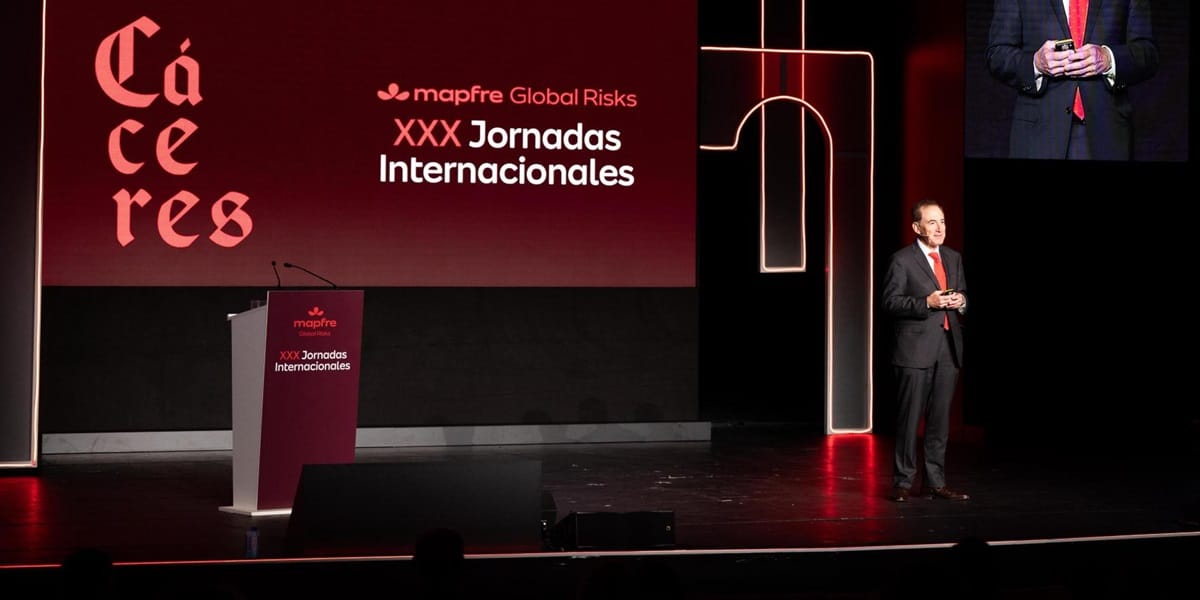
Antonio Huertas, Group Executive Chairman of Mapfre, brought the International Seminar to a close by thanking the many people who attended and made the most of every moment of the event, with the aim of discussing all the different ways to support the business community and, in doing so, improve people’s lives. He was also especially moved by the choice of his native Extremadura as the gathering place. Representing the region, María Guardiola, president of the Regional Government of Extremadura, also thanked the organizers for choosing Cáceres to host this important sector gathering and highlighted the role of insurance in a field as complex and sensitive as Global Risks.
Very soon, you’ll be able to read a more detailed summary of all the roundtables and talks from the event in our magazine Risk and Insurance Management. Stay tuned!