28/07/2026
Military spending continues to rise. Geopolitical tensions are redefining the risks the defense industry faces. In this scenario, the sector is accelerating its transformation toward more technology-first models while strengthening its production capabilities, innovation, and development capabilities.
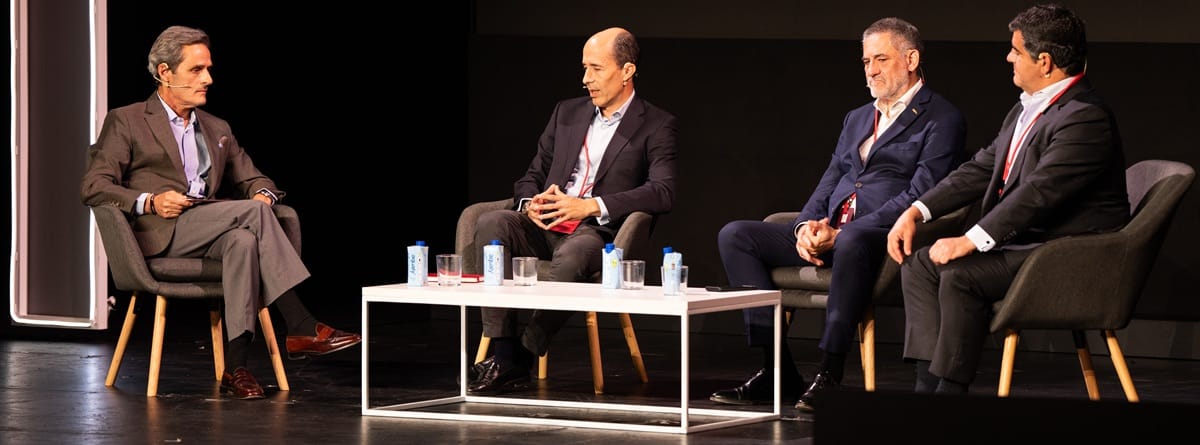
To address this interesting context, the Mapfre Global Risks International Seminar brought together, in a roundtable discussion moderated by Antonio Salgado (the company’s underwriting manager), Javier Bastarreche (Corporate Insurance manager at Indra), Diego de Santiago (Finance manager at Navantia), and Miguel Ángel García Primo (CEO of Hisdesat). The participants analyzed how the new international context is driving the development of the defense industry, the risks associated with this transformation, and the role of insurance in supporting a strategic sector.
More investment in a more complex environment
Antonio Salgado opened the debate by setting the international context, which has seen 11 consecutive years of increased military spending and rearmament. He also reviewed the current geopolitical tensions, such as the war in Ukraine, the conflict in the Middle East, and the growing tensions in Asia, which together paint a scenario that’s especially favorable for the defense industry.
Despite the situation, Diego de Santiago introduced a shared premise: “War benefits nobody.” Even so, this boost in investment has come about in response to new perceived threats and the conviction that Europe must strengthen its own defense capabilities. In this context, the director of Navantia recalled the strategic nature of the maritime sector. “Eighty percent of world trade moves by sea,” he pointed out, emphasizing the importance of protecting Spain’s extensive exclusive economic zone, which is double that of its land mass, through advanced naval capabilities.
To respond to the increase in demand, he explained that the company is strengthening its capacity through investments in innovation, facilities, and production processes. Among the most relevant projects, he mentioned the incorporation of AI, advanced data management, and a digital twin for the F110 frigate, as well as the development of disruptive technologies such as bio-inspired submarine robots.
Technological evolution is also transforming the role of space in defense. In fact, as Miguel Ángel García noted, NATO has considered it an operating domain since 2019, and space infrastructures are essential both for military operations and day-to-day operations.
“Investing in defense means investing in peace,” he declared while defending the value of deterrence as a guarantee of stability. “Most partner countries are actively creating a space force or incorporating space into their armed forces,” he asserted, recalling that a good part of the services we use every day depend on satellites and that protecting those assets will become increasingly important to preserve both security and economies.
Indra’s Javier Bastarreche explained that the company is expanding its traditional role as a developer of technological systems to also become an industrial player capable of driving new defense platforms in a process that combines the technological experience of the civilian sphere with the new needs of the military sector.
Where are today’s biggest risks?
Beyond the growth in demand, the participants agreed that the real challenge is managing an increasingly complex and uncertain environment. In the case of Navantia, De Santiago pointed out that the main risks are concentrated in system design and especially in the supply chain. The increase in defense programs requires that the entire auxiliary industry also increase its productive capacity to accompany that growth. “This global geopolitical or geostrategic uncertainty is here to stay,” he warned, while highlighting the need to anticipate future disruptions. Another major challenge is the speed of innovation. Cybersecurity, AI, and new unmanned systems mean that capabilities and knowledge have to be continuously updated, while the sector competes to attract and retain highly specialized profiles. “You have to innovate non-stop and be constantly evolving if you want to maintain capabilities,” he stated.
Hisdesat sees risks very differently: García Primo explained that “space is a very complex domain”, and that the most complicated aspect comes when a satellite has been launched and any further intervention is extremely limited. Added to this are the conditions that are unique to the space environment: solar radiation, extreme temperatures, and micro-gravity, among other factors. The executive also warned about the strategic importance of ensuring access to certain components and critical raw materials. The tensions experienced during the pandemic or after the start of the war in Ukraine have highlighted the vulnerability of certain supply chains, although it’s considered a challenge that needs to be addressed with a long-term vision.
For his part, Bastarreche emphasized the risk of technological obsolescence. “If you’re not up to date with tech development to respond to the new threats, you’re out of the game,” he said, explaining that this situation forces you to invest continuously in innovation and to incorporate strategic capabilities, as well as to attract and retain the talent needed to develop these technologies.
Insurance is an ally for the future
The last part of the debate focused on the role of insurance in an environment characterized by emerging and systemic risks. De Santiago considers that the insurance market adequately responds to traditional risks, although he warns that new threats pose significant capacity challenges. In this regard, he argued that “we must work hand in hand with insurance companies and be able to anticipate.”
For his part, Miguel Ángel García recalled that the space insurance market continues to be a very specialized niche and pointed out the need for the insurance industry to evolve at the same pace as space technology. “I see insurance as still very conservative and that will have to change,” he said.
Finally, from Indra, Javier Bastarreche emphasized the importance of transparency between insurers and companies to properly understand technological risks. In their opinion, not all risks can be transferred, so it’s essential to strengthen both preventive management and public-private collaboration to address those systemic risks that exceed the capacity of the insurance market. “We need to prioritize communication and transparency above everything else,” he concluded.
If you want to listen to the full talk about the future of the defense industry, don’t miss the roundtable discussion “Risks associated with the defense and protection industry of global strategic systems.”