07/11/2023
In order to combat climate change, Latin American countries are trying to form sustainability guarantees in all sectors. Construction, due to its environmental impact and contribution to the economic development of the region, is an essential objective.
Among the many initiatives being carried out nationally, we are approaching the international CEELA project. This project seeks to train and advise professionals in Latin America to promote energy-efficient buildings, adaptive comfort, and low or zero CO₂ emissions, especially in hot climate zones such as Colombia, Ecuador, and Peru. From her technical team, Johana Infante, a specialist in sustainable construction, reminds us that, in the world, construction accounts for approximately 39% of CO2 emissions. This is one of the leading causes of global warming. “It is expected that there will be an increase in emissions in the sector over the next few years, mainly associated with the increase in final energy consumption in buildings and especially in electricity use”, she says.
In the case of Latin America, construction accounts for 21% of operational CO2 emissions. These are associated with electricity and natural gas consumption, representing nearly 50% of total consumption. “To reduce emissions, the most relevant measures are achieving a low-emission electricity matrix, efficiency in building design, and self-generation of electricity in buildings”, she warns, along with the use of renewable energy systems in buildings, such as photovoltaic systems or solar thermal systems. In this regard, the CEELA Project has published a comprehensive guide of recommendations and criteria. It is a starting point for learning about the multiple aspects to be taken into account and the standardized terms of reference for the region.
Elements required for the transformation
The CEELA project has defined a list of principles, which together make it possible to design, implement and then operate buildings with high energy efficiency and adaptive comfort (EEAC). These would be:
• Principles of Design and Construction. Measures that mainly consist of passive or bioclimatic design, and planning.
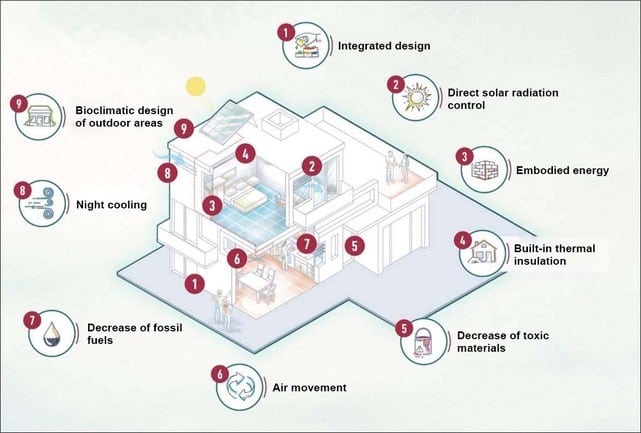
Principles of Design and Construction. Source: CEELA Project.
• Technical principles. Strategies with active systems, whether regarding the provision of climate control or lighting, or the self-generation of energy in the building.
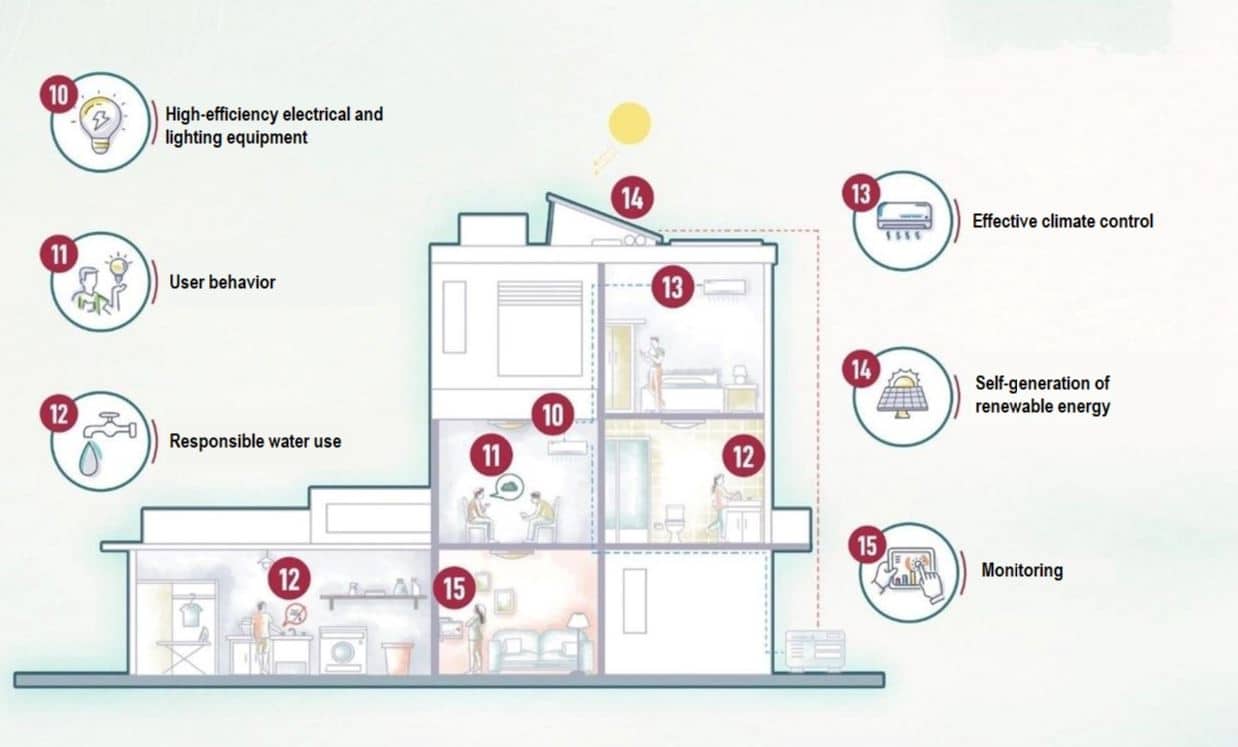
Technical principles. Source: CEELA Project.
As she explains, the implementation of these criteria “requires taking into consideration various aspects in all phases of design. This integrated design is a strategy that has many advantages when implemented from the early stages of the project, as it seeks to optimize energy efficiency and thermal comfort jointly between architectural and engineering parameters”, in addition to allowing verification of the technical, economic, and cultural feasibility of the construction from the early stages.
Enhancing the value of local industry
Johana Infante emphasizes that the principle of incorporation promoted by her project refers to incorporated variety, “used for materials, products, and construction and deconstruction work” in all phases of construction. “A well thought-out optimization strategy with respect to incorporated energy helps mitigate the growing material shortages in the construction industry”, she warns. For this, it is preferable to “use locally sourced materials. Recycled materials, and those with high recyclability, should be a priority. Additionally, consideration will be given to reducing the use of materials such as concrete or steel where local structural design guidelines and construction processes allow”, she says.
The CEELA Project promotes the development of sustainable construction through the design of model buildings that are environmentally responsible and committed to the well-being of people. One of the initiatives carried out was the DAMMAR residential complex. A social housing project located in the city of Cartagena (Colombia) that incorporates natural ventilation and emphasizes the control of direct solar radiation. Academic buildings have also been constructed in Nazca (Peru) and Cuenca (Ecuador). “All model buildings will be monitored after the construction stage, where the efficiency, renewable energy, and comfort of each project will be measured and analyzed with a monitoring system based on environmental and energy parameter sensors, data storage, and visualization”, stresses the expert. A user survey system and an evaluation of electricity bills and environmental parameters are also carried out.
Renewable energy and responsible water management
The renewable energy market has reached commercial parity with other conventional forms of energy and the CEELA Project highlights solar energy as one of the most technically and economically feasible alternatives. “Our focus is on the use of suitable surfaces with photovoltaic solar energy, as the demand for climate control (powered by electricity) usually coincides with the highest supply of solar energy. Thermal solar collectors are useful for hot water generation. In warmer areas, solar thermal collectors may be able to meet the low demand for hot water (showers, washing)”, she says.
Another key aspect of sustainability is the responsible use of water, for which guidelines should be established that include “information on the sizing and selection of water-saving devices and accessories (for example, toilet tank capacity, outlet limiter, etc.) and the expected water consumption for standard use”, she concludes.
Article collaborator:

Johana Infante, an architect graduated from the Catholic University of Colombia, with a Master’s degree in sustainable construction specializing in energy auditing and building certification from the University of La Coruña, Spain. She is part of the CEELA Project team, an international cooperation initiative, as technical coordinator in the implementation of model buildings and in the regulatory axis for the construction of buildings with energy efficiency and adaptive comfort principles.