28/05/2026
Thursday, May 28
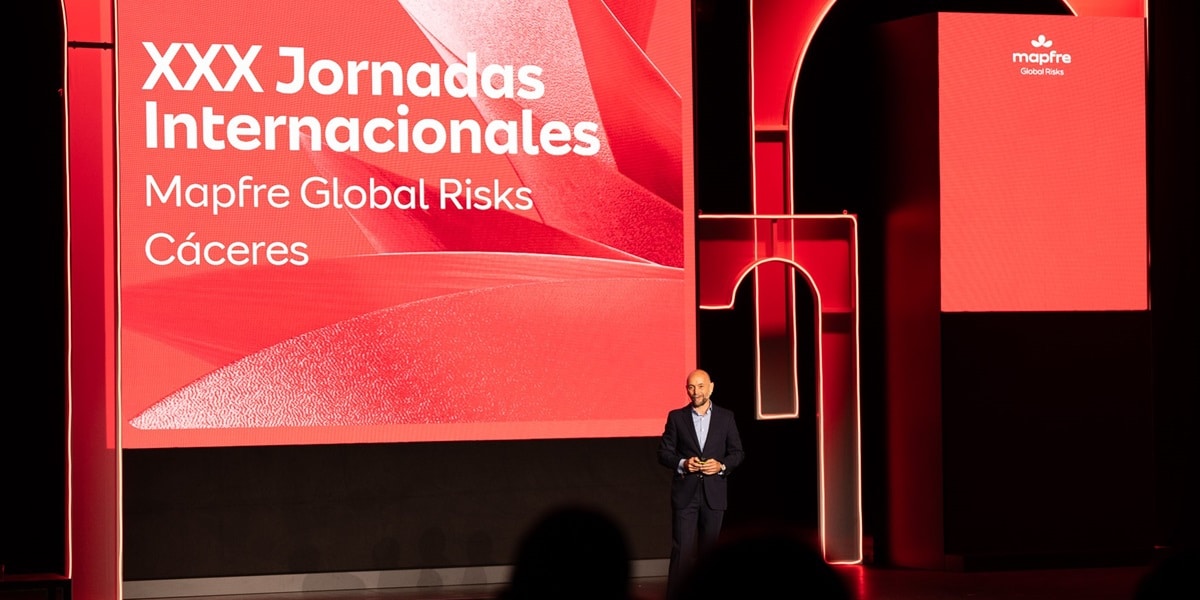
Eduardo Pérez de Lema, chairman of Mapfre Global Risks, welcomed the attendees once again to the Seminar, which is celebrating its 30th edition in the city of Cáceres. The meeting brings together hundreds of professionals from the sector through an interesting program that’s focused on the main challenges and opportunities facing the industry.
During his presentation, he focused on the current context of geopolitical uncertainty, technological transformation, and social change, highlighting the role the insurance industry plays as a key facilitator of stability and solutions. He also emphasized Mapfre’s strength and sustained growth, which closed 2025 with record results, and stressed that the company’s position on technology as a driver was very necessary, but supported by a humanistic artificial intelligence conceived as a tool at the service of people.
For his part, Bosco Francoy, CEO of the company, emphasized the value of insurance as a key element in ensuring growth, resilience, and business continuity in complex environments, stating that “risk isn’t about what’s managed, it’s what determines how far you can grow.” Under this long-term idea, a shared focus with the theme of the Conference, he defended the importance of building strong and sustainable relationships, and highlighted the role of prevention, engineering, and Mapfre’s technical expertise.
This presentation gave way to Juan Francés, group head of brand and reputation at Mapfre, who presented the rebranding of Mapfre and Mapfre Global Risks, a brand evolution aligned with the strategic and organizational transformation that the Group has undergone over the last few years. During the session, he highlighted how this new identity reinforces the company’s positioning as an approachable, solid, and global ally for customers and stakeholders.
A complex geopolitical context
Once again, José Luis Jiménez, board director and CFO of Mapfre, was responsible for delivering one of the most revealing presentations of the seminar, as he shared an analysis of the international economic and geopolitical context, providing insights to help understand many of the challenges that will shape the business and insurance panorama in the coming years. During his intervention, he made special mention of the current situation in the Middle East from a historical perspective, recalling that more than 80% of armed conflicts “have an economic motivation behind them”, emphasizing that international tensions directly affect supply chains, which in turn has a direct impact on energy, trade, and global financial stability.
Jiménez also referred to economic and trade uncertainty, growing public debt, and the impact of conflict on global growth scenarios, which is much higher than that of major natural disasters. Although his presentation didn’t ignore current international tensions and the potential consequences of this escalating global fragmentation, he concluded his talk with the positive inspiration of Keynes, appealing to the capacity of societies to adapt and progress: “If we’re able to envision what the future holds, we can create it.” He noted that in the last 100 years, real income has increased sevenfold, infant mortality has fallen from 34% to 4%, and literacy has risen from 32% to 90%. With this, he conveyed a final message of confidence in progress and, above all, in the future.
Roundtable. Security and cyber risks: how to manage and secure the invisible risk
The first meeting of the workshop was moderated by Julien San Quirce, Underwriting manager for TPL at Mapfre Global Risks, and featured Macarena Bandrés, head of Cyber Risk Management at Marsh, Ignacio del Corral, global manager for Enterprise Insurance at Santander Group, and Daniel Largacha, Cybersecurity manager at Mapfre.
As was highlighted at the beginning of the debate, global risks are no longer understood solely as a physical threat, but also as a digital one, and one that can have an immediate impact on companies, markets, and financial systems. Against this backdrop, it was emphasized that “the problem doesn’t start with technology, the problem starts with people”, since cybercrime has perfected its ability to exploit the human factor through phishing or ransomware, with direct consequences in the form of financial losses, operational interruptions, and reputational damage.
The situation is far from simple. As Largacha acknowledged, it’s “impossible to have a perfect and complete map of these risks,” since technology operates on a different plane than the physical, is volatile, and the threats it presents evolve at lightning speed. Del Corral highlighted the importance of transversality of the impact of cyber risk, which means involving all areas of the company by building scenarios that facilitate anticipating the potential impact of an incident across different dimensions of the business. He also highlighted the difficulty of quantifying damages, which can range from loss of earnings to significant sanctions.
For her part, Bandres emphasized the role of the broker as a key figure in connecting customer knowledge with the insurance market, helping to design solutions that are adapted to each organization’s own reality. Overall, the panel highlighted that managing cyber risk is no longer just a technological issue, but a strategic issue.
Roundtable: Macro reinsurance overview
The next conversation was moderated by José López González, deputy general manager of Business at Mapfre Re, accompanied by Bryan Dalton, senior vice chairman and underwriting manager – Property at Rennaisance Re, Tim Jehnichen, executive chairman of Munich Re in Spain, and Pablo Muñoz, global CEO for Facultative Reinsurance at Gallagher Re.
All the professionals gathered for this talk agreed that reinsurance, in this context of uncertainty, must focus its value proposition on customer retention. “We’re not seeking general growth, but rather long-term support and diversification,” Jehnichen assured. For his part, Dalton considered that the market is now more competitive and that it’s essential to protect investors, maintaining both efficiency and competitiveness. Gallagher Re is also committed to diversifying and continuing to grow in a market that’s not static, both in products and in geographic spread. From Munich Re, the message struck a note of caution: “We have to stay alert, but we can’t paralyze ourselves.”
Pablo Muñoz regarded public-private collaboration as important, understanding that the market “can’t solve all problems” on its own, and that in this context the insurance industry can only exclude risks, reduce uncertainty, and bring some clarity. Dalton added: “You have to be patient and understand the point of the cycle we’re in. Risk has to have a double meaning,” he assured. Before closing the conversation, Jehnichen recalled that “confidence comes with consistency and systematization.” “When problems arise, they see you as a strategic ally,” he concluded.
Flash focus. Data centers: driver of the new digital economy
During his intervention, Iván Delgado de Robles, Risk, Services and Concessions manager at ACS, explained how the company’s commitment to data centers has evolved, driven especially by the growth of AI and the strong demand for digital infrastructures. ACS has been building data centers for years through subsidiaries in the United States and other countries, although focused solely on the construction phase. The big change occurred in 2023-2024, when the rise of AI accelerated the decision to create a specific business unit to cover the entire data center cycle: design, construction, operation, and maintenance.
To be able to incorporate this model, ACS has relied on partners like BlackRock, noted for their global international deployment. Together they’ve increased their global presence, supported by various lines of business: comprehensive solutions, infrastructure and concessions and engineering and construction (the latter led by Turner in the U.S. and Dragados in Europe). In the data center area, Turner plays a key role as a global leader in building these infrastructures, especially for large hyperscale operators. Wrapping up, Delgado stated that “data centers, which are increasingly larger and with power consumption needs of hundreds of MW and even GW, will require greater insurance capacity to cover their growing operational, technological, and energy risks.”
Talk. Maritime and logistics corridors: the role of critical infrastructure
This conversation between Alev Sümer, underwriting management associate at Mapfre Global Risks, and Hakam Kayganaci, CRO of CoreX Holding, revolved around how geopolitics, supply chain disruption, cyber risks, and climate change are redefining risk management in critical infrastructure, especially in sectors such as ports, logistics, energy, and mining.
Kayganaci explained that the current environment is increasingly volatile and less structural, where events such as the ongoing conflict in the Middle East show that risk is no longer punctual but systemic, and that companies need to get used to managing risk from the start of the investment cycle, integrating it into the business strategy.
One topic in this area that was addressed again was the need for diversification and resilience, both geographically and in terms of material assets. He also emphasized that traditional insurance is useful for specific risks, but less effective against prolonged geopolitical and regulatory changes.
Climate change was addressed as a factor already integrated into investment decisions, not only from the physical impact, which conditions the financing and design of any critical infrastructure. To conclude, the CoreX CRO expert insisted that resilience has become the new currency, especially in an environment where risks are interconnected, and adaptability and business continuity are more important than pure efficiency.
Roundtable: European captives and international programs
The last session of the first day of the seminar brought Bosco Francoy back to the stage, this time alongside François Beaume, vice-president of Risks and Insurance at AMRAE, Luis Lancha, president of AGERS, and Laurent Nihoul, CEO of FERMA. During the roundtable, the rise of captives in Europe and their growing role in managing global risks were discussed. The speakers agreed that the tightening of the insurance market in recent years has driven the use of captives, especially in large multinationals, but increasingly in smaller companies too.
Captives have gone from being a niche tool, with 80% of them located in Ireland and Luxembourg, to becoming a structural element of financial management that can now be found in other countries. France is now a success story thanks to its reform of June 7, 2023, which legitimized the captive market, and where they’ve grown from 6 to 28. France has also created a federation of captives to generate an ecosystem that can act in the long term and deliver continued growth.
Spain, for its part, is at a key regulatory transition moment, linked to the transposition of the 2025 European directive, although its success will depend on regulatory proportionality, the clarity of the fiscal framework, and the development of a solid ecosystem. Finally, the panel emphasized the transformation of the role of the risk manager, which must evolve toward a more strategic and transversal function. It’s no longer just about measuring risks, but about influencing business decisions, speaking the language of the business, and acting as a translator between exposure and strategy. That is, moving from a tactical role to a strategic and financial one.
Flash focus. The future of health in the company in a world powered by AI
The last presentation of the day looked at the impact technology, especially AI, is having in health in an enterprise environment. Pedro Díaz Yuste from Savia (Mapfre’s digital health initiative) highlighted that AI is already transforming the healthcare sector, and recalled the statements of Demis Hassabis, CEO DeepMind and Nobel Prizewinner in Chemistry, who stated that this technology can revolutionize medical research and accelerate the cure of diseases.
At corporate level, Díaz Yuste emphasized that companies face significant challenges related to the well-being of their employees, the increase in mental health problems, absenteeism, and periods of leave. In this context, he explained that there are four major areas where AI can provide value: prevention and early detection of diseases, digital orientation and triage, personalization of medical recommendations, and development of AI-supported therapies. These advances are already a reality in private health.
Finally, the speaker explained how Mapfre is incorporating these solutions both in its health insurance business and through Savia, its digital health services platform, with the goal of offering more accessible, preventive, and personalized care.