05/08/2026
Rare earth minerals have gone from being largely unknown to becoming strategic materials for energy transition and the digital revolution. Found in everything from cell phones to electric cars to wind turbines, extracting and processing them poses significant environmental and geopolitical challenges.
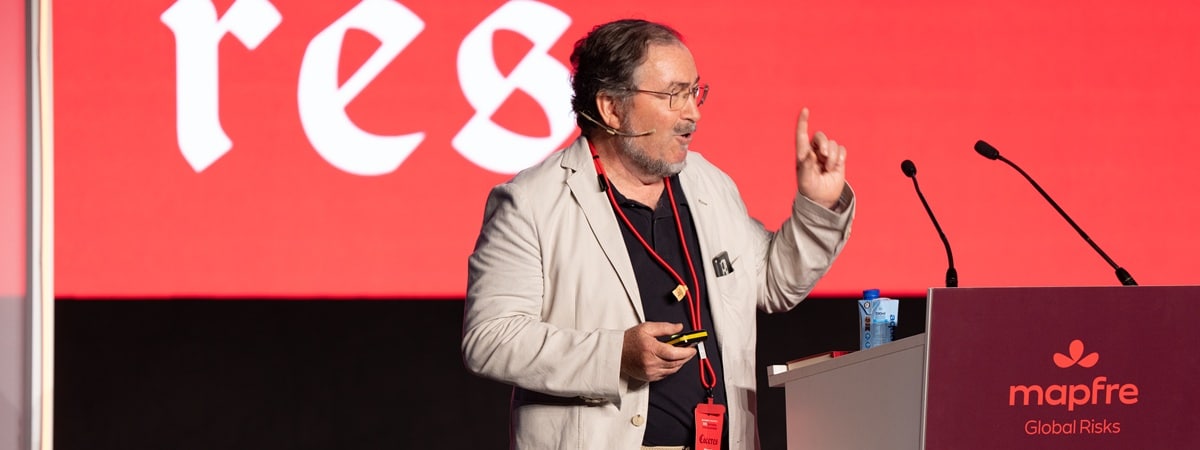
During the XXX Mapfre Global Risks International Seminar, Manuel Regueiro, technical manager of the Official College of Geologists, addressed the strategic role of these elements and how their given denomination is wildly misleading. “Rare earths are neither earths, nor rare,” he explained at the beginning of his speech. In reality, we’re talking about a group of 17 chemical elements — lanthanides and two others with similar properties — whose value lies in their physical characteristics. Said elements form a multitude of minerals (up to 180) and compounds.
The term comes from the 17th century, when they were identified as “earths” because they appeared in the form of oxides. The prefix “rare” comes from a poor translation of the English term “rare earth,” which refers more to the difficulty of extracting and exploiting them than to their actual scarcity.
Essential pieces of modern technology
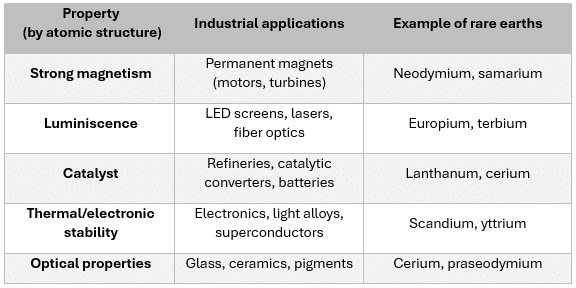
Rare earths are fundamental because of their particular atomic structure: “Strong magnetism, luminescence, thermal stability, optical properties, among other characteristics.” Thanks to them, materials with the same properties can also be manufactured. This chemistry is present in countless everyday objects. A cell phone contains rare earths in its magnetic and optical components. The motors and electronic systems of modern vehicles have rare earth minerals built into them. Wind turbines require large amounts of permanent magnets. As we can see, these elements are an intrinsic aspect of todays’ technology-focused society and yet all too often go unnoticed.
Among the grouping, Regueiro highlighted neodymium iron boron magnets (NdFeB), which account for 45% of global demand for rare earth elements. These magnets are vital components of smaller and more efficient engines used in small-scale electronics and EV and renewable infrastructure.
How China came to dominate a critical value chain
The main international concern isn’t so much the existence of the resource, but who controls its transformation today. China holds a dominant position in practically every phase of the process: mining, chemical separation, refining, and manufacturing of components. In addition to possessing abundant resources, the country has managed to position itself as the main manufacturer and supplier of these materials. “China doesn’t make money selling its various rare earth minerals around the world. It makes money by selling us neodymium magnets,” said Regueiro. The real business isn’t in extracting the mineral but in controlling its entire value chain.
This industrial advantage turns rare earths into a genuine geopolitical tool: a region may have mineral resources underground, but if it lacks the capacity to refine and manufacture, it remains dependent on other powers or regions. The clearest example is permanent magnets: China concentrates most global production, which makes any trade restrictions a risk for entire industries.
In 2019, global production of rare earth oxides was estimated to be about 160,000 tons per year, of which 95% came from China. The reserves were estimated between 80 and 120 million tons, an amount sufficient to cover demand for the next 625 years. “It’s worth pointing out that these reserves are to be found mainly in China,” the expert noted. According to the United States Geological Service (USGS), 2023 data show global production at 353,320 tons per year and reserves at 115 million tons. The main producer remains China, with 240,000 tons (67% of global production), followed by the United States, with 43,000 (12.7%).
The energy transition needs more minerals
One of the main messages coming from this presentation at the seminar was that decarbonization doesn’t eliminate our dependence on resources – it transforms it. EVs, electricity networks, and renewable energies require large amounts of copper, lithium, nickel, and rare earths. “Mineral resources will be required to make the energy transition happen,” said Regueiro. The problem is that opening new mines takes a long time. From identifying a site, doing the necessary research, securing permits, and then finally starting production, 15 years can pass by. For Regueiro, this doesn’t add up: economies want to accelerate the energy transition, but the mining industry works on long deadlines and large investments.
The situation in Spain is complex. The country has signs and deposits of rare earths – Matamulas in Ciudad Real, Monte Galiñeiro in Pontevedra, and carbonatites in Fuerteventura – but none are currently being extracted. This reflects the global debate between strategic autonomy and environmental protection. Some projects have failed to get going because of the environmental impact associated with mining. “If we allowed this country to exploit the resources we have, we would be the leading producer in Europe,” Regueiro stated. In any case, having the resource doesn’t automatically mean being able to use it: technology, investment, permits, and industrial capacity are needed.
The race for independence in critical minerals
Against this backdrop, the dispute over rare earths is part of a much broader competition for access to the critical minerals necessary for the energy transition and digital transformation. The United States, the European Union, and Japan are trying to reduce their dependence on China through strategic reserves, international agreements, and investments in new extraction and processing projects.
Japan has progressively reduced that dependence thanks to an industrial policy focused on diversifying suppliers and strengthening its own production capacity. Europe has also launched initiatives to ensure the supply of critical raw materials, although with some delay compared to other powers. However, the challenge isn’t just to locate new deposits, but to develop a complete value chain. Rare earths remain invisible to most consumers, but they’re essential for manufacturing a large part of the technologies that support the current economy. Controlling them won’t just be a mining issue, but also an industrial, energy, and geopolitical issue. “The question is whether we’ll achieve strategic autonomy in critical minerals without making holes in the ground,” concluded the expert.