02/07/2026
Geopolitics, digitalization, and climate change are transforming how ports and logistics corridors are managed, in a new scenario where resilience has become a key criterion and insurance takes on a strategic role.
In a global context characterized more than anything by uncertainty, critical infrastructures are no longer designed solely to maximize efficiency, but to also guarantee the continuity of operations.
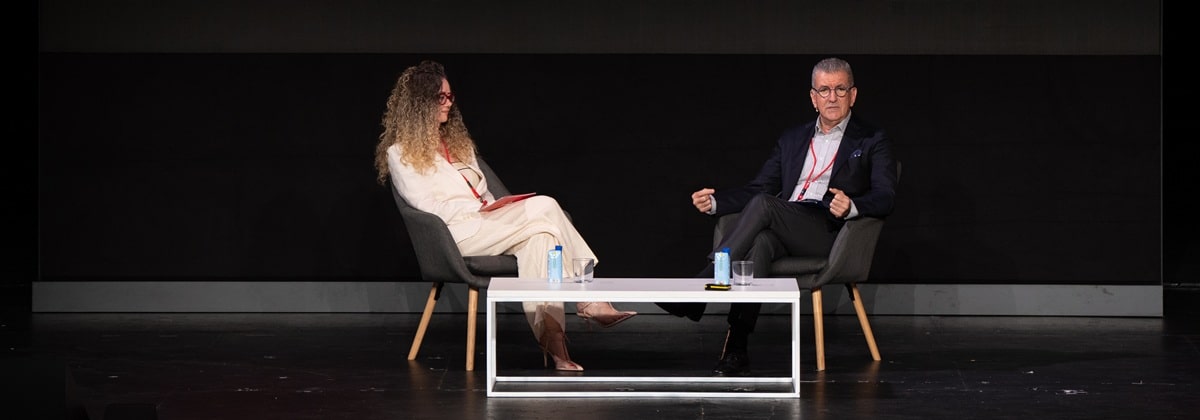
As part of the XXX Mapfre Global Risks International Seminar, Alev Sümer, deputy underwriting manager at Mapfre Global Risks, spoke with Hakan Kayganaci, CoreX Holding CRO, about how investment criteria and port and terminal management are changing.
From traditional insurance to comprehensive risk management
In strategic industries, threats have ceased to be a secondary element to address and are now an essential criterion of overall business strategy. “We don’t just buy an insurance policy – we manage risk,” explained Kayganaci, who argued that “risk is no longer something that’s transferred at the end of the process. It must be incorporated from the very design phase of the business.”
CoreX Holding’s senior executive recalled that risk management, insurance, and investment decisions are evolving to become a single integrated process, especially in capital-intensive sectors like logistics, mining, or renewable energy.
Geopolitical uncertainty has also changed the way new investments are evaluated. Country risk (indicator that measures the political, economic, and financial stability of a country) has become one of the main decision-making criteria. With this index, the company analyzes regulatory stability, the strength of counterparties, and cash generation capacity, in addition to subjecting each project to stress tests. In this context, Kayganaci warned of the limitations that the insurance market still presents in certain scenarios: “Insurance can cover specific events, yes, but it can’t cover systemic geopolitical changes.”
Connected risks: geopolitics, cybersecurity and climate
Automation and digitalization have increased exposure to cyber risk, raising operators’ concerns. According to Kayganaci, the greatest vulnerability is found “where information technologies (IT) and operational technologies (OT) intersect, especially when legacy systems must coexist with new digital layers.” For this reason, he urges insurers to adopt a more data-driven risk engineering approach that is oriented toward realistic scenario analysis. Although he admits that cyber insurance has evolved notably in recent years, it’s still “not fully prepared to respond to large-scale operational disruptions.”
Climate change adds complexity to these challenges, already affecting access to financing and infrastructure planning. “It’s been quite a while since I’ve seen a financing operation that doesn’t require a specific assessment of climate risk,” he stated. We’re moving toward an analysis that’s no longer limited to the physical effects of extreme weather events, but which also incorporates the risks arising from the transition to a low-carbon economy and the evolution of the regulatory framework.
Artificial intelligence and other systemic risks
The CoreX Holding executive warned that artificial intelligence (AI) is set to transform logistics planning, improve predictive maintenance, and risk modeling. This technological advance entails, in turn, a paradigm shift as far as security is concerned. “Risks associated with the AI models themselves, cybersecurity, and the governance of these technologies will appear. Consequently, the risk profile will change. We’ll probably see fewer individual incidents, but a much greater exposure to systemic risks,” he asserted.
However, the greatest concern isn’t a specific risk, but the accumulation of several at the same time. “The greatest risk for the next five years will be the simultaneous interaction of climate, cyber, and geopolitical risks,” Kayganaci warned, considering that the industry is still not prepared to respond to scenarios of this complexity.
Resilience is at the core of future investment
In this new scenario, resilience takes center stage, meaning adaptability is now the key ingredient of any business plan. “We’ve stopped designing our operations solely seeking maximum efficiency. Now we try to design them with maximum flexibility,” summarized the manager.
This reality also requires rethinking the role of the insurance industry. For Kayganaci, insurers must now be involved much earlier on in the development of projects. The need to participate from the early stages of investments, risk analysis, or financing. For this alliance to be consolidated, the expert identified three areas of action: the exchange of data to improve stress tests, risk engineering adapted to emerging threats, and the development of more personalized solutions, such as parametric coverage and multi-trigger solutions that are capable of responding simultaneously to climate risks, operational risks, and cyber risks.
Before concluding, Kayganaci recalled that ports and terminals don’t just manage strategic assets, they also facilitate flows of goods and trade, wand any interruptions to this critical activity can have consequences throughout the economy. As such, he insisted that “resilience has become the new currency of growth” and argued that insurers must evolve from a model based on mere risk transfer to a true strategic alliance. “We’d like insurance companies to be much more than just simple policy providers. We’d like to see them acting as genuine investment partners,” he concluded.
If you want to learn more in detail about this new international logistics scenario, don’t miss the full Maritime and Logistics Corridors: the role of critical infrastructures talk.