08/09/2026
Risk management enters a new technological era thanks to an innovation that facilitates evolving from prevention that’s based on periodic inspections to a predictive and continuous model, thereby strengthening industrial safety and anticipating potential failures.
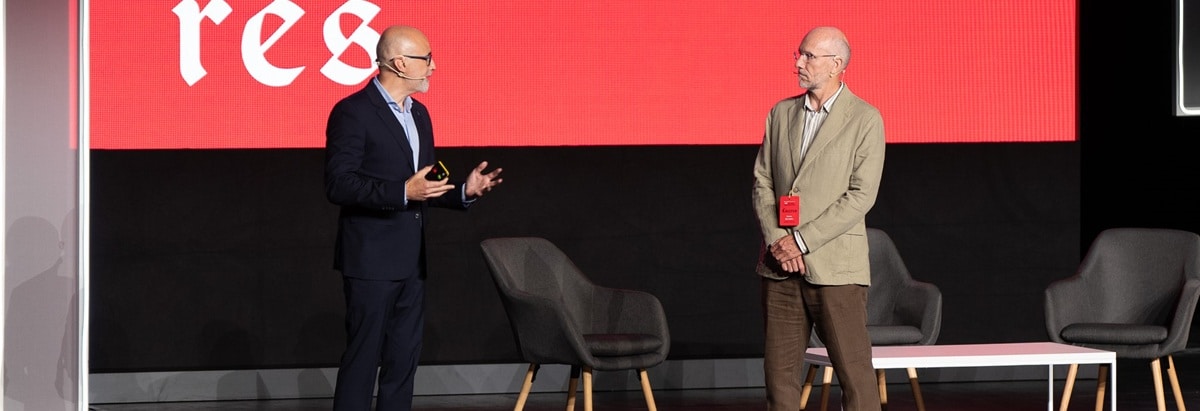
The incorporation of smart sensors, AI, and autonomous systems capable of detecting anomalies before they become an incident positions prevention as a fundamental pillar of risk management. As an example of unstoppable technological evolution, the XXX Mapfre Global Risks International Seminar hosted a talk moderated by Óscar Estrada, assistant manager for Intelligence at Mapfre Global Risks, and featuring the participation of Carlos Bernabéu, CEO of Arbórea Intellbird.
Through real examples and a dynamic live demonstration, the experts showed how sensor technology is transforming predictive maintenance and, with it, expanding insurance possibilities in sectors where exposure to risk complicated providing the right coverage.
Technological promotion
Óscar Estrada began his contribution by recalling that prevention is one of the fundamental principles of Mapfre’s engineering work. He explained that the energy transition and the incorporation of new technologies are modifying risk profiles, and this means that prevention tools need to evolve too. The proliferation of photovoltaic installations is a good example of this new reality: although they help reduce emissions, certain structures, such as installing combustible roofs, can increase the risk of fire if hot spots appear that aren’t detected in time. Incorporating sensors that can continuously monitor the thermal behavior of these systems means potential incidents can be anticipated.
Carlos Bernabéu addressed the possibility of detecting measurable signals long before a serious failure occurs. “The useful life of any facility is marked by wear and tear processes that we can observe with the right technology,” he explained. The sensors developed by Arbórea Intellbird enables automatic identification of these anomalies, which are processed via AI and sent as real-time alerts when parameters exceed established thresholds.
The system operates completely autonomously: it analyzes the thermographic images, evaluates the risk level, and sends the information directly to the maintenance managers, accompanied by the thermal image and the corresponding alert level. “We aim to anticipate problems before the fire ignites,” added Bernabéu.
Automation to reduce risk
One of the central messages of the presentation was the growing role of automation in preventive management. Bernabéu explained the evolution of technological systems from those that require constant intervention by the operator to fully autonomous models, capable of monitoring, analyzing, and acting without human intervention. Estrada reinforced this idea by recalling that the human factor remains essential to provide criteria and experience, but it also constitutes an inevitable source of error. “Automatic systems have a much lower failure likelihood than any manual process,” he said, arguing that incorporating sensors delivers increased supervision reliability and less dependence on periodic inspections. Far from replacing people, these tools allow professionals to focus their efforts on decision-making and on dealing with incidents that are truly relevant. The combination of sensorization, AI, and predictive maintenance means pivoting from a reactive logic to a forward-looking strategy.
During the session, different practical applications of this technology were illustrated. One example was the installation of fixed thermal sensors at Mapfre’s global headquarters in Madrid, where they continuously monitor a photovoltaic plant and generate automatic alerts when they detect temperature deviations that could lead to a failure. Bernabéu also presented ground robots capable of autonomously traversing large photovoltaic parks while performing clearing tasks, inspecting the facilities, and detecting hot spots in real time. Equipped with satellite communication, these systems send immediate warnings when they identify any anomalies that require intervention. He also showcased applications involving drones and mobile platforms to monitor industrial infrastructures, conveyor belts, electrical panels, or storage facilities for sensitive products.
Innovation that expands insurance capacity
Beyond the technological aspect, the presentation focused on the impact that these solutions can have on the insurance industry. As Óscar Estrada explained, having continuous information about the condition of the facilities means that risks that were previously difficult to assume can now be covered. “Sensors open the door to expanding insurance capacity in sectors where there are currently significant limitations,” he said. Combining sensors, AI, and predictive maintenance improves risk awareness and facilitates much more precise management of exposures, benefiting both insured parties and insurers.
The practical demonstration conducted during the presentation, in which a thermal camera analyzed the heat generated by the attendees and by various devices present in the auditorium in real time, pedagogically showed how technologies that just a few years ago seemed like science fiction are now part of the tools the industry uses to manage its risks.
The session concluded with a reflection on the innovation process. Estrada resorted to the metaphor of surfing to explain that major technological transformations must be identified and taken advantage of at the right time. Innovating requires experimenting, collaborating, and maintaining constant contact with the environment so opportunities aren’t missed. Bernabéu went even further, defining the current moment as a change of enormous magnitude: “Innovation isn’t a wave anymore, it’s a tsunami.”If you don’t get on it, you’re lost.” Bernaéu closed his speech with a sentence that summed up the spirit of the presentation: “This is the future we saw as kids in the films.”
If you want to watch this presentation in full and see how the practical demonstration went, you can watch the recording of the Remote Sensor for Thermal Anomaly Detection presentation on our YouTube channel.