19/11/2026
Traditional maritime insurance asks a fundamental question: what level of damage have the goods suffered, and what is the amount of the loss? But what happens when the cargo arrives in perfect condition and, even so, its commercial value has decreased?
Parametric insurance offers a new way to address these risks. Instead of assessing the damage, this insurance modality establishes in advance what event must occur to trigger a financial benefit being paid out. Its application to maritime transport opens up new protection possibilities but also poses important technical and contractual challenges.
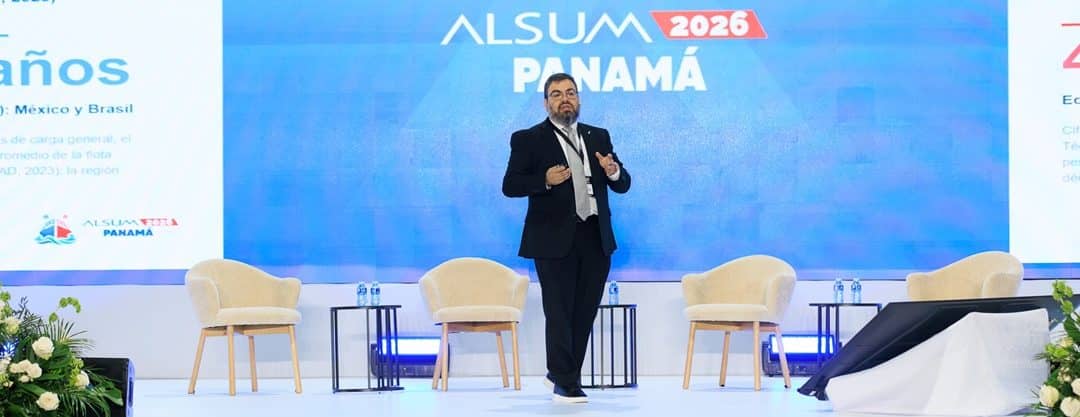
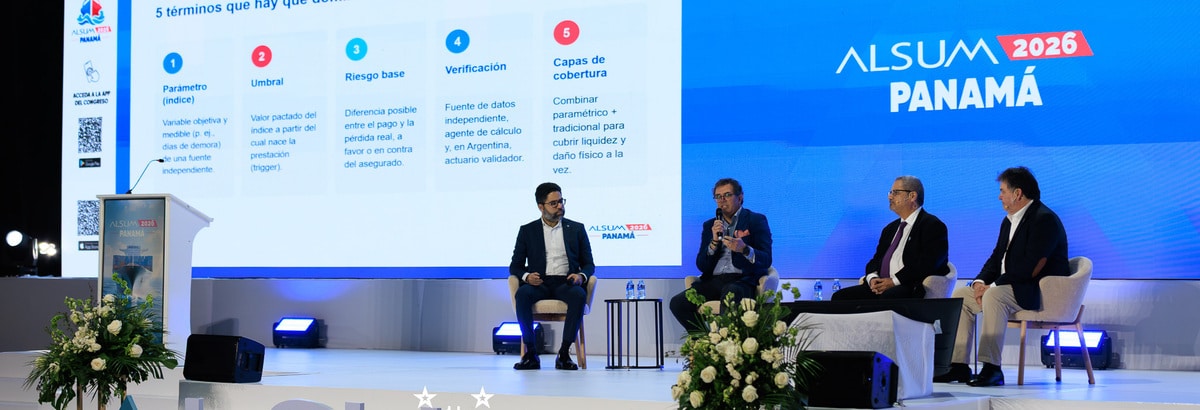
Within the framework of the latest ALSUM Latin American Marine Insurance Congress, held recently in Panama, its Legal Observatory brought together some of its professionals in a presentation titled Legal complexities of parametric insurance: an approach to implementation in Marine. After the formal introduction by Omar Córdova, director of the Alsum Legal Observatory, participants included Ernesto Santos Ortiz from Seguros Universal; Antonio Alexander Valdivia Olivares from Viollier y Asociados; José Guillermo Stoute Carbajal from IME; and Jaime Iván González Astudillo from Probitas Latam Adjustment Corp.
From assessing the damage to measuring what happened
Omar Córdova opened the session by recalling the origins of maritime insurance and the evolution of a business model that, since the first meetings of merchants and shipowners at Lloyd’s coffee house in London — one of the oldest and most important insurance markets in the world, whose origins date back to the 17th century — has maintained the logic of sharing navigation risks. However, he presented a significant sector-specific alternative: “Parametric insurance doesn’t ask how much you lost – it asks what happened.”
Antonio Alexander Valdivia explained the fundamental differences between the two systems. While in traditional maritime insurance it’s necessary to prove the damages and determine the amount of the loss, with parametric insurance, payment depends on an objective index and a threshold previously established in the policy. When that limit is exceeded, an economic benefit agreed upon from the beginning is activated, which means evaluation processes and settlement times are reduced.
To understand how it works, he explained three concepts: the parametric index, which represents the variable to be measured; the activation threshold, which determines when the coverage is activated; and the base risk, which reflects the possible difference between the expected payment and the actual economic loss of the insured party. This last one constitutes one of the main challenges for underwriters, who must ensure that the parameters chosen adequately represent the customer’s exposure. Valdivia also clarified that both modalities are not mutually exclusive. A company can maintain traditional insurance to protect the goods against physical damage and take out specific parametric coverage for transportation delays.
How can the model be transferred to maritime transport?
To address the application of these products to the maritime sphere, José Guillermo Stoute explained that these insurance policies can be linked to usual activity events, such as ship transit, loading/unloading operations, or port activity. Although there is no specific and unique definition of this type of insurance, its operation is based on identifying events that can be measured and objectively verified with the appropriate tools. Among those available, the Automatic Identification System (AIS) stood out, which facilitates tracking a ship’s movements and port stops, port terminal records, and container monitoring systems. These latter can provide information about temperature variations or power supply disruptions during the journey.
Stoute insisted that the data must be independent, traceable, and consistent, which means they come from reliable sources, be verifiable, and provide consistent results. The quality of the information is fundamental to determining if the event that activates the coverage has actually occurred.
The legal and regulatory challenge
Ernesto Santos focused on the legal implications of a model in which payment doesn’t necessarily depend on demonstrating an actual loss, but rather on the occurrence of a previously defined parameter. This difference raises issues related to the indemnity principle, consumer protection, and the solvency of insurance entities.
The group of experts analyzed the regulatory experiences of several Latin American countries and found that a homogeneous framework does not yet exist. Colombia shows progress in the recognition of the index as proof of the contract. Chile stands out for expressly including logistical variables and delay variables among the possible scenarios for applying these insurance policies. Argentina requires feasibility studies and technical and actuarial validation, while Peru has advanced in regulating data sources, independent validations, and calculation agents.
For Santos, one of the essential aspects is that the contractual conditions clearly establish the sources of information, the verification mechanisms, and the possible alternatives when there are divergences between the data. Transparency must be present from the design of the policy to avoid disputes when the event occurs.
A practical and paradigmatic example
The presentation by Jaime Iván González helped illustrate how these insurance policies work in practice. A group of Peruvian table grape exporters shipped merchandise worth 40 million dollars, departing from the port of Callao. The boarding, consisting of 9,350 tons distributed over 500 refrigerated containers, had to arrive before the Christmas holidays. However, the Crown container ship docked in its destination port on January 2. The merchandise arrived in perfect condition, and the temperature had been maintained within the right parameters, but the commercial window had passed, and the competing Chilean production was beginning to arrive. As a consequence, the consignment of grapes lost approximately half its value.
The case highlights one of the limitations of traditional insurance: the goods hadn’t suffered physical damage and the delay, except for specific coverages, was excluded from the policy. The possible claim against the operator also did not guarantee an immediate or sufficient recovery. According to this example, exporters could end up bearing losses of between 17 and 20 million dollars. In such a situation, parametric insurance could offer complementary protection based on the transit time.
Throughout the presentation, the experts agreed that parametric insurance can offer new responses to risks of this magnitude, which aren’t always covered by traditional policies. However, they also recognized that developing them requires very rigorous prior work, in addition to transparent contracts adapted to each operation.