02/09/2026
The reinsurance market is beginning a cycle marked by competitiveness, pricing pressure, and an uncertain geopolitical environment. In this context, the sector is banking on technology, innovation, and strategic alliances to continue providing value.
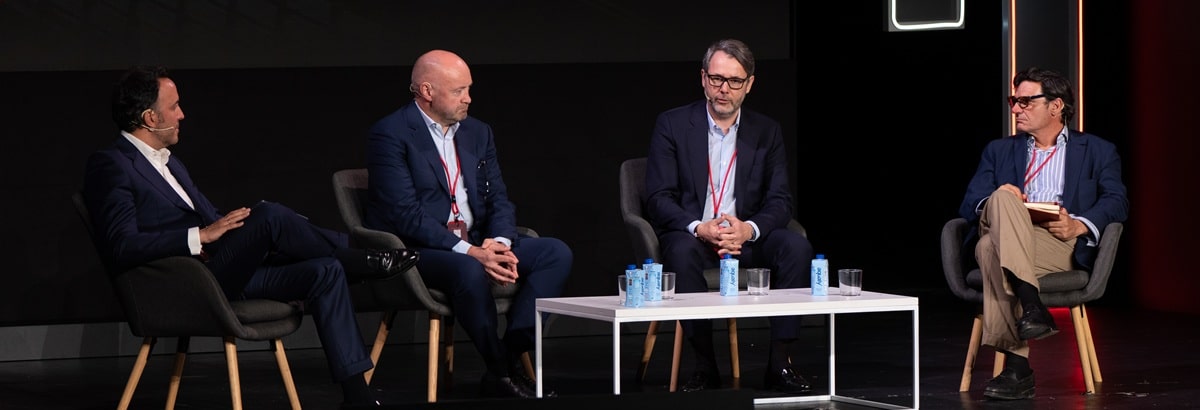
To address the current situation in the industry, the XXX Mapfre Global Risks International Seminar brought together Tim Jehnichen, CEO of Munich Re Spain, Bryan Dalton, Senior Vice President and Head of Underwriting – Property at Renaissance Re and Pablo Muñoz, Global FAC CEO of Gallagher Re, in a roundtable moderated by José López González, Deputy General Manager of Business at Mapfre Re.
An increasingly competitive market
José López began the talk by recalling how, in just two years, the market has gone from a tightening of the cycle to a scenario of greater competition and pressure on rates. Together with the other participants, he noted that the principles underpinning the business remain unchanged. Munich Re’s Tim Jehnichen explained that the market continues to offer favorable conditions, although it also demands scrupulous risk selection. “We have to be strategically intelligent in how we deploy our capacity,” he stated, emphasizing that the objective is not to grow at any price, but to concentrate capacity on those businesses that generate sustainable profitability over time. Diversification and stable relationships with strategic customers are the true pillars of the business.
For his part, Bryan Dalton recalled that competitive markets are part of reinsurance normality. In his opinion, the real challenge is to strike a balance with profitability. “Price is probably the last and simplest thing to talk about,” he pointed out. Before reaching that aspect, it’s essential to understand the customer’s data, analyze how the risk is evolving, properly design the coverage structure, and define the contractual conditions.
From the intermediary’s perspective, Pablo Muñoz highlighted that soft markets also represent an opportunity to review capital allocation and foster innovation. In his opinion, these cycles favor the development of new products, drive portfolio diversification, and allow for the redesign of risk transfer solutions to adapt them to the new customer needs.
An uncertain geopolitical context
Over the last 25 years, the reinsurance business has operated alongside landmark events like the 9/11 attacks, the international financial crisis, and the pandemic. Currently, geopolitical conflicts are dictating the global agenda. “This type of uncertainty has always been part of our business, and as professionals, it’s very much top of mind when we analyze inflation or the increase in the cost of the assets we insure,” Dalton assured. The expert explained that rigorously analyzing each risk and continuing to offer solutions aligned with any scenario are very much part of the work of a reinsurer.
Tim Jehnichen agreed that geopolitics needs to be incorporated into underwriting processes. “Political and social uncertainty has ceased to be an exceptional circumstance. They are permanent elements of the environment we operate in. We can’t avoid this. We need to live with it. And as has been pointed out, we can’t allow it to paralyze us: on the contrary – we need to tackle it head on and with better tools.”
For Pablo Muñoz, crises also drive market developments. He recalled that many of the major changes experienced by the sector arose precisely as a response to extraordinary events. However, he argued that certain systemic risks (especially those associated with geopolitical conflicts) will hardly be absorbed exclusively by the private market. “The solution has to come through public-private collaboration,” he stated.
Disasters cease to be exceptional
Losses deriving from natural phenomena can no longer be understood solely as extraordinary events. The so-called secondary risks and other unmodeled hazards increasingly generate recurring claims, and as such are becoming a structural element of the risk profile of insurers and reinsurers. Pablo Muñoz underlined the importance of continuing to develop modeling mechanisms, enhancing solutions such as parametric coverage, and taking advantage of facultative reinsurance (where individual risks are negotiated one by one, allowing the insurer to freely decide what to cede and the reinsurer to decide whether to accept or reject each case) to design programs adapted to complex risks.
Jehnichen agreed that the market must concentrate its capacity on major catastrophic risks and avoid systematically transferring high-frequency losses to reinsurance that could be managed via direct insurance. Additionally, he focused on prevention as one of the great challenges in the coming years and defended the need for pricing to incorporate signals that encourage better risk management. Dalton recalled that the sector has been investing for decades in developing natural catastrophe models, although it hasn’t yet found the right balance. “We keep making mistakes, but we know that we are less wrong than we were yesterday,” he said. The information provided by customers will likely allow for a better understanding of the exposures and proper differentiation of the risks.
The role of insurance in the market
In this drive for active collaboration with customers, Tim Jehnichen insisted that sharing knowledge and strategically supporting clients can improve our understanding of risk. Dalton noted that reinsurance can’t be understood as a simple good and that at Renaissance Re, building strategic relationships means being more patient, better understanding the customer’s business, and maintaining a long-term vision throughout the entire cycle.
Pablo Muñoz closed the debate by reminding those present that trust underpins any relationship between insurers, reinsurers, and brokers. That trust, he explained, must be based on transparency, consistency, and the ability to continue providing solutions even when the environment becomes more complex. “Transparency, without a doubt, is key,” he concluded.
If you want to hear the entire conversation, you can watch the Reinsurance: cycle, risks and strategic value video on our YouTube channel.