01/10/2026
Our dependence on outer space as a resource is increasing at an unprecedented pace. Communications, transport, meteorological observation, or emergency management use systems located in space. But what happens when the orbital environment starts to become saturated?
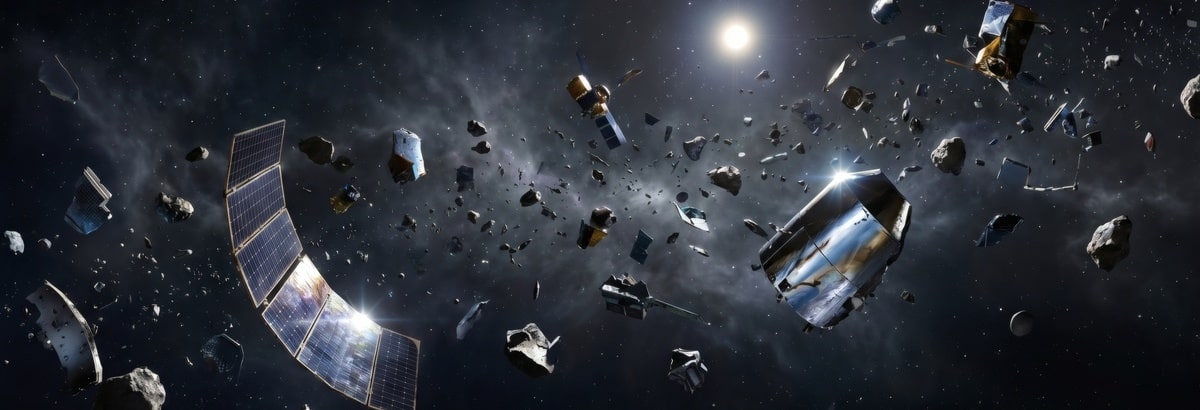
The number of satellites, as well as components from previous missions, is steadily increasing. This accumulation makes the orbital environment more complex and increases the risk of collisions that can compromise not only a space asset but also services and infrastructures that are essential to the smooth operation of numerous functions on our planet.
The problem in figures
The expansion of mega-constellations has especially accelerated this phenomenon in low Earth orbit (LEO), where a significant part of space activity is concentrated. Some of the most used areas, located between 400 and 600 kilometers in altitude, account for a large number of active and maneuverable satellites.
According to the European Space Agency (ESA), around 46,000 objects are currently tracked periodically by space surveillance networks. But this figure doesn’t represent everything that’s in orbit. ESA’s latest report on the space environment estimates the number of objects larger than 10 centimeters at 54,000, with 1.2 million objects between 1 and 10 centimeters and about 130 million objects between 1 millimeter and 1 centimeter.
On top of that, every collision can generate hundreds or thousands of new fragments, which in turn increases the likelihood of further impacts. This chain reaction is called the Kessler syndrome, which could make certain orbital regions progressively more difficult to use.
Impact on Earth
The problem goes beyond the satellites themselves. Ground-based processes and services rely heavily on space-based services, so any interruption can quickly impact critical infrastructure and public services like communications or transport.
This dependency is present in navigation, telecommunications, Earth observation, and meteorology systems. There are also many less immediately obvious uses, such as the synchronization of financial and energy networks, fleet management, logistics, or emergency response.
Therefore, the magnitude of a collision isn’t limited to the value of the lost space asset. It can include service interruption, replacement cost, and the economic and operational impact for companies and users.
A study commissioned by the ESA to London Economics warns that a hypothetical interruption of satellite communications during a seven-day period could generate an impact of up to 20 billion euros across agency member states and Canada. The analysis includes sectors such as maritime transport, aviation, energy, and payment services.
Traffic prevention and management
The first line of action is to prevent new space trash from being generated. This implies incorporating sustainability criteria into the design of each operation: reducing the release of components, avoiding explosions at the end of their useful life by removing stored energy, and planning how to remove the satellite when it has completed its function.
The demands in this area are increasingly greater. In 2023, the ESA updated its requirements and reduced the post-mission limit in the protected region of low Earth orbit to five years. The new regulation also requires that the cumulative probability of collision with objects larger than one centimeter during that period is to be less than 10-3.
But prevention alone doesn’t solve the problem: better coordination of space traffic is also needed. As the number of objects increases, encounters that require evaluating possible collisions and, in some cases, performing evasive maneuvers become more frequent. This requires having more precise monitoring systems and sharing information about the position and trajectory of the objects.
Surveillance is especially complex when it comes to small waste. NASA points out that objects less than one centimeter are difficult to detect and track with conventional technologies.
Waste disposal
Although new launches comply fully with current recommendations, there are still countless out-of-service satellites and other component remnants that will remain for years in orbit and could pose a threat.
That’s why the active removal of waste is becoming increasingly important. One example is ClearSpace-1, a project driven by the ESA that aims to remove the PROBA-1 satellite from orbit. Another spaceship must locate and autonomously approach the decommissioned unit, capture it, and guide it towards a controlled re-entry into the atmosphere.
This type of operations poses notable technological and economic challenges. Intervening an object that’s moving at several kilometers per second, capturing it, and changing its trajectory requires great precision. Furthermore, it’s necessary to determine who assumes the cost of removing objects that may come from missions from different operators and that, in many cases, have been in space for decades.
International waste mitigation standards establish recommendations, but implementing them is largely conditioned by national mechanisms and by action taken by the operators themselves. Evolving towards more demanding standards and greater international coordination will be decisive in reconciling the growth of the space sector with the protection of a shared environment.
A new dimension for risk management
The increase in the presence of satellites in orbit also poses new challenges for risk management, and the growing concentration of objects in space requires accurately assessing the exposure of each mission and anticipating possible loss scenarios.
The ESA is advancing in new ways to analyze this scenario, and its latest report estimates that 96% of the risk index in orbit is associated with inactive objects, especially rocket remnants. This sobering data point highlights the need to strengthen prevention, monitoring, and management of threats in the space environment. For organizations that depend on space assets to continue providing their services, this context requires broadening the perspective: it’s not enough to just protect your own assets, it’s also essential to understand external dependencies and the possible effects of an interruption on mission-critical operations and services.