16/07/2026
Electrification, technological innovation, and growing geopolitical uncertainty mark a turning point for the energy sector, which is facing a profound transformation and requires the support of the insurance industry to move forward.
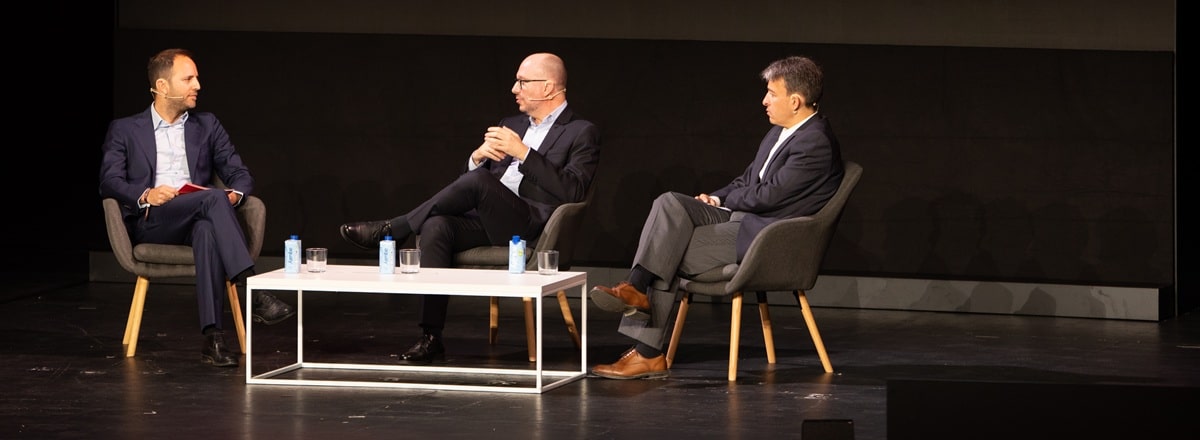
These were some of the main issues addressed in the roundtable discussion “Electrification, global geopolitics and energy transition: challenges and opportunities for insurance”, which took place during the XXX Mapfre Global Risks International Seminar. Alberto Mengotti, Underwriting Manager of the Mapfre Global Risks Energy Area, spoke with Orlando García, Corporate Head of Loss Prevention at ENGIE, and Ramón Presa, Upstream and Downstream Insurance Manager at Repsol, about the main challenges this energy transition poses and how collaboration between companies and their insurers can facilitate the process.
Electrification: a challenge full of opportunities
The electrification process constitutes one of the main challenges of the energy transition process, although, as Orlando García pointed out, each problem has brought with it a new possibility for the market. “A network problem is an opportunity,” he declared, to explain how the need to expand electricity capacity is favoring the development of new infrastructures, storage systems, and modernization projects in different markets.
Ramón Presa acknowledged that in recent years Repsol has undergone “a profound transformation”, pivoting away from being an oil company toward a more diversified profile, in a process that added to the sum of its parts and in which different technologies coexist. “Not everything can be achieved through electrification,” he stated, citing sectors like aviation and maritime transport, which still need low-carbon fuel, hydrogen, or synthetic fuels to advance in their transition.
Both agreed that this electricity demand will remain high for decades to come, especially in the context of industrial processes and buildings, the latter driven by population growth and improved life expectancy in many economies.
Geopolitics as a determining factor
The global political situation impacts the advancement of the energy transition and redefines the economic power of the main global powers. If international dependence was historically concentrated in oil and gas producing countries, it’s now shifting toward the supply of critical minerals or the manufacture of solar panels or wind turbines.
Many of these supply chains are concentrated in China, which holds a dominant position both in critical mineral processing and in the manufacture of essential components for the transition. “China has a market share of more than 80% in all these components, which generates a tremendous dependence that’s very geographically localized,” said Presa, who also issued a note of caution on the great exposure deriving from the growing digitalization of the sector’s infrastructure. “We’re introducing new risks of an international scope,” he explained, referring to the vulnerability to cyberattacks and the growing complexity of increasingly interconnected systems.
Another of the latent risks in the international scene is the one that threatens supply security. While the Middle East continues conditioning energy supply to Asia through the Strait of Hormuz, the war in Ukraine has laid bare the energy vulnerability of a large part of Europe. In this context, Repsol’s executive highlighted the capacity of the Spanish system to deal with potential tensions thanks to the investments made in recent years in refinery and gas infrastructure.
“In Europe, 35 refineries have closed in the last 15 years. Fortunately, Spain decided to swim against the tide and bet on more investment at the worst moment of the 2008 crisis. I dare say that we’re not going to have those shortage problems that other countries in Europe may suffer from because we’ve done our homework in that regard,” he said.
ENGIE’s Orlando García explained that geopolitics also directly influences investment decisions. The company adjusts the pace of development of its projects based on the level of uncertainty in each region, accelerating those markets that offer greater stability and growth potential. In any case, he emphasized that the main priority remains protecting people, pointing out that international conflicts also affect the availability of personnel, manufacturers, and contractors.
New models of risk management
This international scenario is changing the way risks are assessed and managed. Orlando García considered that part of the insurance market continues analyzing these facilities with criteria inherited from conventional technologies, when therefore, the challenge is really to identify which are the priority threats in each energy source.
For his part, Presa acknowledged that the lack of insurance capacity for certain projects continues to be a major obstacle, both for historical activities and for the most recent initiatives. This situation generates a contradiction that can hinder the advancement of the energy transition itself, since it’s precisely the conventional businesses that provide much of the necessary resources to finance decarbonization investments.
In this context, both speakers agreed on advocating for a new relationship model between insurers and energy companies. Presa highlighted the value of having stable partners who support the development of long-term projects and cited Mapfre as an example of this collaboration model, emphasizing both its insurance capacity and its technical knowledge.
He also stated that it’s important for collaboration to begin at the start of the project life cycle, from the design, engineering, and risk analysis phases. The experience accumulated after numerous claims, the understanding of the modes of failure, and the ability to share lessons learned can be differential factors in improving risk management and facilitating the financing of new investments. “Insurance companies and corporate prevention areas are a source of information that we have to take advantage of. Their involvement in projects is key,” he stated.
For his part, Orlando García emphasized the importance of sharing information and called for a greater exchange of data, loss ratio statistics, and operational experiences that allow companies to anticipate risks and make better decisions.
If you want to delve deeper into this analysis of the challenges of electrification, check out the roundtable discussion “Electrification, global geopolitics, and energy transition: challenges and opportunities for insurance”.