21/07/2026
Reviewing the past is also a way to understand the present and anticipate the future. In his speech at the Mapfre Global Risks International Conference, José Luis Jiménez offers a brief history lesson to better face uncertainty.
The geopolitical and international economic scenario is marked by uncertainty. Conflicts, the struggle for control of strategic resources, and growing trade tension are redefining global hegemonies.
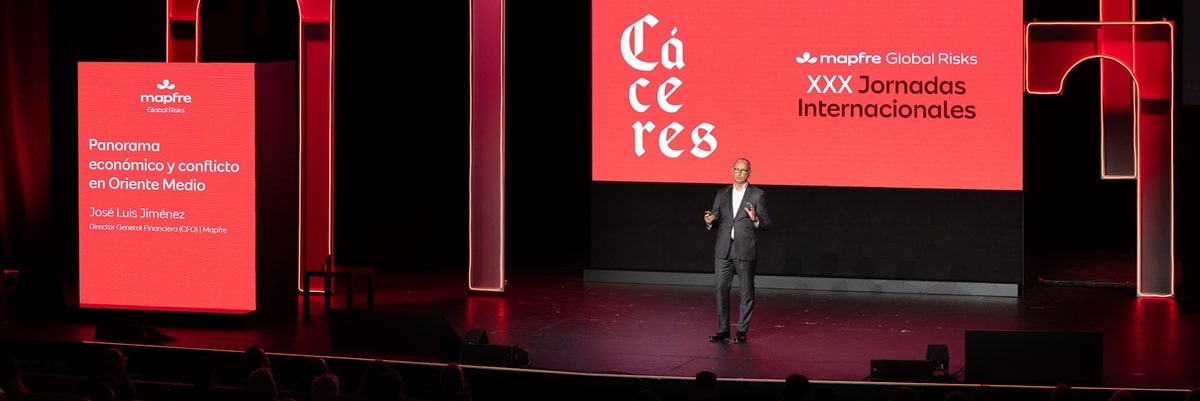
Once again, José Luis Jiménez, CFO of Mapfre, offered a joint vision during the Mapfre Global Risks International Conference, held in Cáceres. On this occasion, his intervention started from some historical parallels to analyze the geoeconomic keys of the crisis in the Middle East and its possible effects on energy, trade, supply chains, and financial markets. A story that shows how rivalries between powers, access to resources, and economic interests have shaped conflicts over time.
When geopolitics is marked by the economy
Political and ideological disputes often hide a struggle for resources, trade routes, or strategic positions. “There is a mix of power and money, but usually the economic reason, the geoeconomic reason, is always there,” Jiménez stated at the beginning of his speech.
As an example, the expert looked back to the First Punic War (264–241 B.C.) when Rome and Carthage clashed for control of Sicily. The island, besides its geographic importance, was a key territory because of its agricultural resources and its position on the Mediterranean trade routes. The conflict thus reflected how economic interests can be behind seemingly political or military disputes.
More than two thousand years later, this relationship between economics and conflict remains relevant. From there arises a term increasingly used today: geoeconomics, which refers to the use of resources, trade relations, and economic dependencies as tools to achieve political objectives.
In the Middle East, this dimension is especially visible in the Strait of Hormuz. Before the war on Iran, about a quarter of global maritime oil trade passed through it, according to the International Energy Agency. The closure of the strait has directly affected supply and has contributed to the increase in prices, to the point that the IEA has called for its reopening and has warned of a drop in global crude oil supply.
The real impact of uncertainty
An extraordinarily uncertain geopolitical scenario does not always find a proportional response in the financial markets. Jiménez showed various indicators of uncertainty and emphasized the high level of concern existing both in the global economy and in trade, worsened by the war.
The economic effects are not limited to the countries involved: affect energy, trade, investment, public spending, and supply chains. Oil is one of the main thermometers of this situation. However, despite the magnitude of the disruption, its price remains below the levels reached during other major crises. The increase in production of countries outside the Gulf and the releases of strategic reserves have allowed compensating some of the loss of supply, although the full recovery is not immediate.
The dimension of disruption helps to understand the problem. According to the data shown by Jiménez, the conflict affects about 20 million barrels of oil per day, around 17% of the global supply, compared to the 7% that was affected during the Iranian revolution of 1979. “There is an energy dependence,” he stated, referring to the vulnerability of increasingly interconnected supply chains.
Despite the scenario, the reaction of the financial markets has been relatively contained. Jiménez pointed out that the U.S. stock market fell by only 6%, far from what is considered a correction. In the bond market, credit spreads remained low. “If the bond market sneezes, the stock market catches a cold,” he summarized to explain that it is the former that sets the tone in the financial markets.
The apparent contradiction between economic uncertainty and market behavior is, precisely, one of the elements that most concerns the expert. Added to this is the high level of indebtedness: The debt of developed economies is approaching 110% of GDP, compared to around 70% thirty or forty years ago, while public deficits remain around 5% and forecasts indicate they will persist in the near future.
A future difficult to gauge
Predicting how the Middle East conflict will evolve is complex. Jiménez resorted to game theory to propose three possibilities: escalation, negotiation or containment. For the expert, cooperation is possible, but reaching an agreement is complicated. The interests of the different actors do not always coincide and, in their opinion, that makes it difficult to achieve stability.
In the short term, the expert believes that we cannot know what is going to happen. In the long term, it changes its perspective and bets on optimism, recalling John Maynard Keynes and his famous essay ‘The Economic Possibilities for Our Grandchildren,’ written in 1930, in the midst of the Great Depression. In the face of the pessimism of that moment, Keynes imagined what the world would be like one hundred years later and even suggested that income could multiply between four and eight times thanks to capital accumulation and the exponential growth associated with compound interest.
His vision is striking considering that this prediction came from a world that did not know semiconductors, antibiotics, nuclear energy, Internet, or artificial intelligence. However, he understood that the human capacity to generate knowledge and productivity could radically transform living conditions. Today we look to the future knowing that the possibilities are endless.
Jiménez also recovered an idea from the philosopher David Deutsch, and from his work “The Beginning of Infinity,” published in 2011, according to which problems are inevitable, problems have solutions, and solutions create new problems. This sequence fits with economic history and with the current moment: Each advance generates new challenges, but also new possibilities. The closure of the expert was hopeful. “Optimistic does not mean being the locus who buys a lottery ticket and thinks he is going to win: consists of imagining a better future and working to make it possible,” he concluded.
At Mapfre Global Risks, we invite you to read Javier Caamaño’s article and not miss José Luis Jiménez’s presentation from the Mapfre Global Risks International Seminar.