29/10/2026
Environmental insurance is an increasingly strategic coverage
Environmental insurance is a form of insurance coverage that enables companies to transfer part of the cost of preventing and repairing the damage their commercial activity may cause to water, soil, and biodiversity to an insurer. Far from being a marginal line of business, it’s become a central element of any industrial risks program, driven by an increasingly demanding regulatory framework that has been devised around the polluter pays principle (PPP).
Understanding this coverage requires going beyond the policy and knowing what risks exist, how they’re analyzed and evaluated, and what mitigation measures are in place to reduce the probability of them materializing. That is precisely the perspective that risk engineering provides: connecting the physical and operational reality of a facility with the technical design of the insurance coverage.
Environmental insurance coverages
Traditional third-party liability and property damage policies aren’t designed around pollution – they usually exclude environmental risks or limit it to sudden and accidental episodes, and don’t consider gradual pollution and, almost always, repairs to the locus of the incident. That’s why there is a need for specific coverage that responds to the full cycle of the environmental claim.
A well-structured environmental insurance policy combines several blocks:
- Remediation of own damages and remediation of third-party damages (on-site and off-site).
- Third-party liability for contamination, in relation to third-party claims for bodily injury, property, or financial loss.
- Business interruption, both internal and third-party.
- Emergency costs and crisis response (immediate content, communication, appraisal).
- And, in some policies, pre-existing contamination, provided that the insured party has declared it before taking out the policy.
Analysis and evaluation of different types of environmental risks
Environmental damage is usually classified into three main categories:
- Damage to protected species and protected habitats (biodiversity)
- Damage to the water and
- Soil damage, typically caused by activities such as waste management, industrial discharges, or the storage and transport of hazardous substances.
For insurance purposes, it’s also advisable to distinguish between sudden pollution (a spill or an accidental leak) and gradual pollution (an undetected leak that continues over time), as the severity, detection, and coverage of same can differ significantly.
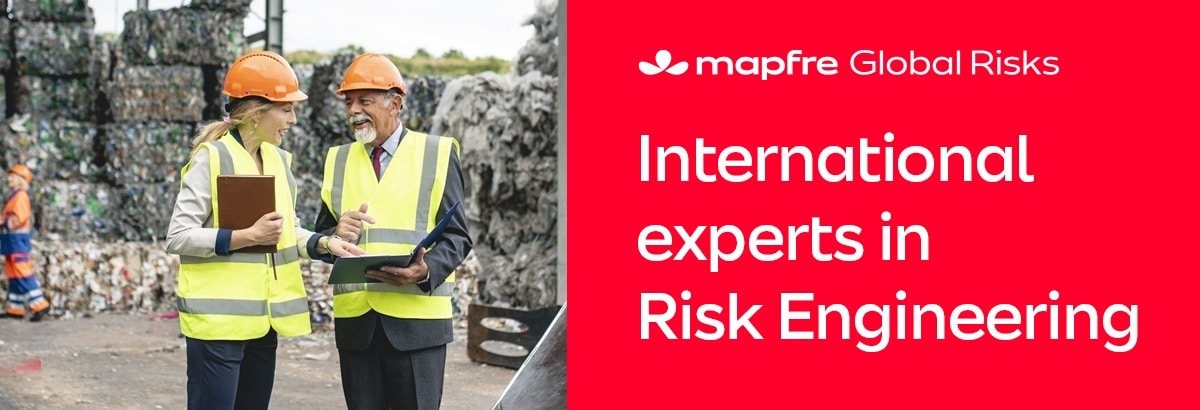
From a risk engineering perspective, the analysis of these exposures doesn’t differ, in terms of methodology, from other industrial risk inspections. The visit to the facility in question facilitates identification of the production processes, the substances and materials that stored and their inter-compatibility, secondary containment systems, proximity to channels, aquifers or protected natural spaces, the status of environmental permits and a history of prior incidents. All of that information is then transposed to a risk matrix that combines probability and severity, and allows for prioritizing the most relevant exposures for underwriting and sizing limits, sublimits, and deductibles. The estimate of the most probable remediation cost —a kind of environmental probable maximum loss— is as relevant as the probability of the event, since the sufficiency of the contracted financial warranty depends on it.
Mitigation measures aligned with coverage
Every day, insurance practice confirms something that field experience supports: although the regulations don’t always impose specific preventive measures, the very existence of environmental responsibility — and its insurance coverage — encourages operators to adopt them. The most common include pollution control equipment, environmental monitoring of the surroundings (groundwater monitoring wells, leak detection), certified environmental management systems, and staff training in incident response procedures.
As far as risk engineering goes, these measures must be directly linked to the conditions of the policy and not treated as generic recommendations. Proper secondary containment in storage tanks reduces the expected severity of a spill and can justify an improvement in the sublimit or deductible applicable to soil damage. A well-rehearsed emergency response plan conditions the actual effectiveness of crisis cost coverage. A robust business continuity plan affects the premium and the scope of interruption coverage.
The value of these recommendations doesn’t lie in their formulation but in their traceability. A measure that’s implemented, documented, and verified in successive inspections updates the current knowledge of the given exposure and allows the coverage to be adjusted in line with the effective evolution of the risk, instead of starting from a static photograph at each renewal.
The value of risk engineering for the insurance market
Spain is among the few European countries (along with the Czech Republic, Portugal, and Slovakia) that already require mandatory financial guarantees for certain activities that are subject to environmental responsibility, as articulated through Law 26/2007 and its model for calculating environmental liability. This framework, which is more demanding than that found across much of the European Union, means the Spanish market is in an advanced position, although it doesn’t exempt it from a fundamental challenge, namely that in the absence of rigorous technical knowledge of the underlying risk, no standard or policy on its own can guarantee that any environmental damage caused will be effectively repaired.
That’s where risk engineering provides its greatest value: translating the physical and operational reality of each facility into useful information that is in turn used to design adjusted coverages, prioritize mitigation measures with real impact, and support the customer in the continuous improvement of their risk profile. In a regulatory environment that will most likely shift towards greater financial insurance requirements, the insurance company’s technical capacity to assess, quantify, and mitigate environmental risk will become increasingly decisive.
Article collaborators:

Óscar Estrada, Engineering assistant manager at Mapfre Global Risks.