13/03/2020
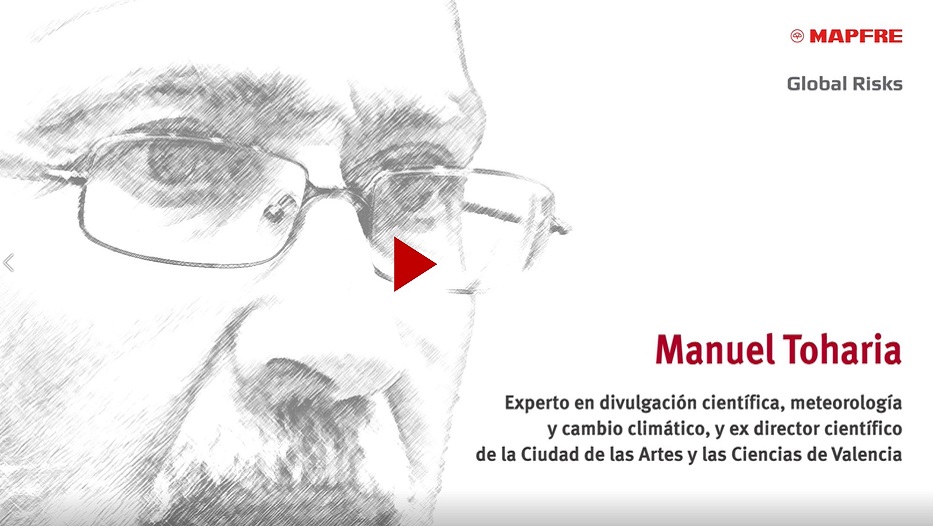
Manuel Toharia is an expert in popular science, meteorology, climate change and was former scientific director of the City of Arts and Sciences complex in Valencia.
In the video interview for MAPFRE Global Risks, Toharia presents his unique vision of climate change, of the mathematical models used in predictions in this field and of catastrophic events.
Toharia believes that there is no relationship between climate change and the tropical cyclones that have occurred in recent years. In fact, he states that, based on the available historical data, not only has there been no increase in the total number of these types of phenomena, but their intensity has not increased either.

“There is no catastrophic correlation at all. There has been warming, yes, but it’s hard to say if it’s on a global scale; and it hasn’t been completely anthropogenic.”
As for global warming, Toharia also has a very clear opinion. He believes that the warming has been natural, and superimposed on an anthropogenic warming—in other words, derived from the hand of man, but we can hardly say that it is global warming.
“Satellites have been providing us with global data for only 39 years. In the past we did not have global data available, so we cannot be sure how representative it is,” explains Toharia.
According to his reflections, the alarmism regarding global warming and the disasters that occur probably lies in the fact that we have many more assets than in the past and, therefore, today we have much more to lose. “Even if there are no more disasters or they are not worse than before, the damage will be greater, progressively, because there are more and more of us and we have more and more. The economic losses will certainly increase,” he explains.
Toharia says that “it is important to raise the alarm, not to alarm. It is necessary to take action against a situation that today could be more economically damaging.”
“It’s a little presumptuous to say what’s going to happen 50 years from now”
Toharia is also emphatic about the predictions and the mathematical models used to make them. “They’re not very reliable, although it’s the best we have at the moment,” he says.
As he explains, the Intergovernmental Panel on Climate Change (IPCC) does not make predictions, it makes trend calculations, within which a margin of uncertainty is estimated.
That is why, in Toharia’s opinion, daring to predict the climate of the whole Earth in 50 years’ time is a foolhardy thing to do.
We present the complete interview together with the reduced interview