20/10/2026
Resilient construction isn’t just about withstanding the swings of extreme weather: it means anticipating its effects from planning to maintenance, integrating design, data, and local nature conditions to keep essential operational infrastructure running smoothly over the long-term.
Climate change is altering the conditions for which a good part of the buildings and the other infrastructure that make up our cities and economies were designed. Roads, bridges, railways, dams, ports, water networks, residential buildings, and industrial facilities will have to operate in a scenario marked by higher temperatures and extreme weather events.
As such, it’s no longer enough to build structures capable of supporting certain loads or buildings that meet energy efficiency requirements. The broader challenge now is to design assets that are capable of functioning even when environmental conditions change.
The construction sector finds itself, however unwittingly, at the center of the climate transition. According to the Global Status Report for Buildings and Construction 2025-2026, prepared by the United Nations Environment Programme (UNEP), buildings and construction represent around 37% of global CO₂ emissions and nearly 50% of global material extraction. The sector also represents between 11% and 13% of global GDP.
Maintaining operability as a priority
A resilient piece of infrastructure is not necessarily the one that remains intact after an extreme phenomenon. It’s one that can prevent, absorb, recover from, and adapt to a disruption, while continuing to function almost wholly as it was originally intended to. This perspective is central to the Principles for Resilient Infrastructure, issued by the United Nations Office for Disaster Risk Reduction (UNDRR). The body proposes jointly considering the life cycle of infrastructure, multiple risks, and the interdependencies between energy, transport, water, sanitation, or communications systems.
In order to do this, it’s essential to properly assess the function of these infrastructures – simple or complex in their form – that support essential services like mobility, transportation, water supply, or electricity. That’s why the real objective of resilience shouldn’t just be to avoid physical damage, but to prevent damage to any given asset from triggering a greater disruption to the wider system.
The IPCC, the United Nations main international body responsible for assessing climate-related science, has also warned about the growing interdependence of services and infrastructure. Cities and their buildings are connected by physical and economic networks, and the impact of climate change can spread among them, generating cascade risks.
Design for the extreme phenomena to come
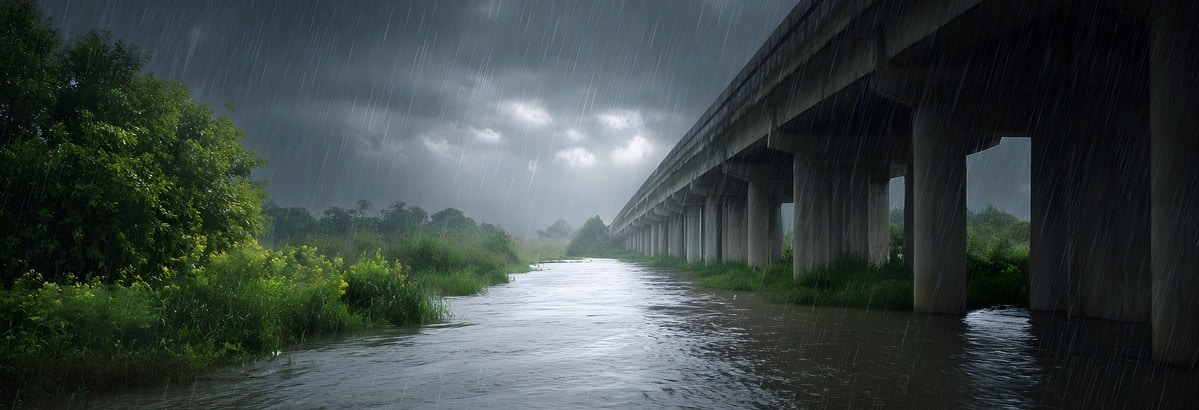
This perspective requires reviewing some of the traditional construction criteria. A road must be built considering not only common traffic conditions but also episodes of extreme precipitation, erosion, high temperatures, or fires. A bridge needs to be constructed analyzing the hydraulic behavior of the channels in future scenarios. A dam has to be built verifying that its evacuation systems continue to be adequate in the face of possible changes in precipitation patterns.
A study by the Polytechnic University of Madrid shows the need to incorporate climate change into the analysis of future floods and the design of hydraulic infrastructures. The Safer Dams project, for example, has studied how climate change can affect the hydrological safety of dams, including the extreme flows used to size the spillways. This principle is applicable to practically any infrastructure: the climate data used in the design phase should represent, as much as possible, the conditions that the asset will encounter during its useful life, not only those it experienced in the past.
The ground is the foundation of real resilience
Real resilience is achieved even before the construction project begins. The location of an infrastructure asset determines a good part of the exposure it will face. The Ministry’s guide for the Ecological Transition on mitigation and adaptation in urban planning states that land planning and construction must take current and future climate conditions into account. Among the measures stipulated are limiting certain uses on lower floors in flood-prone areas, ensuring that buildings don’t pose an obstacle to water drainage, adapting materials and construction elements to the risk of flooding, and considering local wind, solar radiation, temperature, and humidity conditions.
This idea can be directly transferred to the civil works: apiece of infrastructure cannot be considered resilient if its location or relationship with the ground it’s built on generates an exposure that the design itself can’t compensate for. This is especially evident in floods. A road that’s located in a floodable area, a bridge that interrupts a flow channel, or a critical installation located on lower levels can convert into failure points for an entire system.
Orientation, shading, natural ventilation, thermal insulation, reflectiveness of roofs, vegetation, and the design of outdoor spaces can reduce exposure to heat. In the face of flooding, the location of critical facilities, the protection of lower-level floors, the choice of water-resistant materials, and the adaptation of drainage systems can all contribute to limiting damage. Spain’s Ministry for the Ecological Transition and the Demographic Challenge even proposes the creation of spaces that are capable of serving as climate shelters for vulnerable populations during extreme events. It also recommends studying green roofs and facades, highly reflective materials, and ventilation and sunlight criteria that adapt to local conditions.
Nature is part of the solution
Green infrastructure includes natural elements (woods, plains, etc.) and artificial elements (wildlife tunnels or overpasses, fish channels, etc.) that favor the structural and functional connectivity of species and habitats. On land, green infrastructure is present in urban environments, peri-urban environments, and rural environments.
Trees and shaded areas, vegetative cover, permeable pavements, floodable parks, sustainable urban drainage systems, or the recovery of natural spaces can simultaneously reduce different climate exposures. The IPCC identifies some effective measures, such as thermal regulation, storm water management, protection from river and coastal flooding, water management, and urban design, as components of resilient development strategies to combat climate change.
An important aspect to consider in all of this is that the measures must be evaluated in terms of their effect on the entire system. A flood defense that redirects water to another area, a waterproof membrane that increases runoff, or air conditioning that reduces indoor heat but increases electrical dependence, can solve one problem and create another. The IPCC precisely identifies this risk as maladaptation: those actions that reduce a specific vulnerability but transfer the risk in space or time or generate new impacts.
As such, resilience doesn’t consist of building indestructible infrastructure. It is about ensuring that they can continue fulfilling their role in an increasingly changing climate. Incorporating this perspective from the design phase and maintaining it throughout its useful life will be key to reducing vulnerabilities and ensuring the continuity of essential services.