21/04/2026
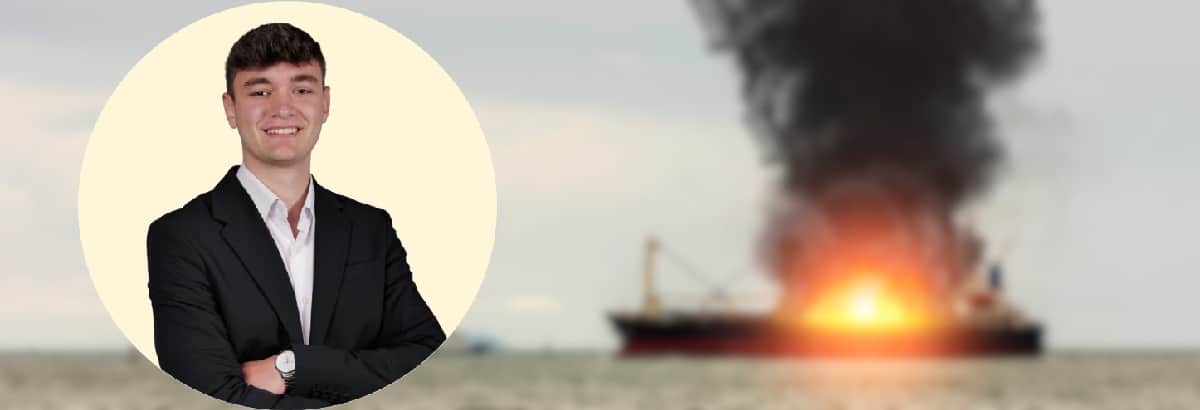
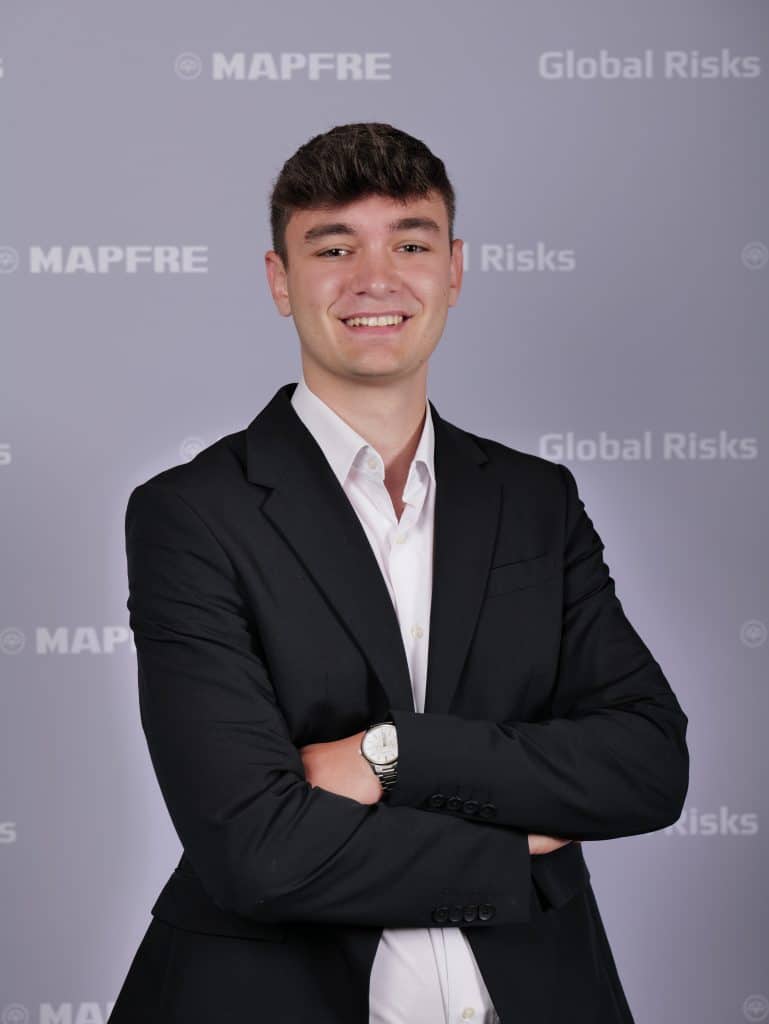
Today we meet Jose María Baños, 23, who’s a Transport and Aviation underwriting analyst in the Operations area at Mapfre Global Risks. He recently completed a master’s in Maritime Business Management and Maritime Law, with an average grade of 9 (humble brag!). So what’s his story?
José María Baños is one of the recent recruits at Mapfre Global Risks. He’s a low profile guy, but cheery and positive, and since July 2024, he’s been part of the Operations team.
Last November, he finished a master’s in Maritime Business Management and Maritime Law, scoring a perfect 10 in the presentation of his final theses, titled Evolution of maritime claims from the perspective of maritime insurance, types and emerging risks, and a final average of 9 across the board.
First of all, congratulations on your outstanding grades in the master’s! What motivated you to study such a specialized topic?
I had the opportunity to complete my university work experience phase in the Transport and Aviation department of the Mapfre Global Risks Operations area, and this introduced me to the world of insurance.
It was precisely at this stage when I realized that I wanted to deepen my knowledge of transport insurance, so I decided to start the master’s in Maritime Business Management and Maritime Law, with the aim of complementing the experience I was gaining during my internship with broader technical and legal training.
Thanks to the trust placed in me by Carlos Villanueva, when I finished internship, I had the chance to join the staff as an underwriting analyst for Transport and Aviation in the Operations area, which really underpinned my motivation to develop my career in this field.
“The initial hypothesis was to analyze how the maritime loss ratio has evolved over the years
and whether this evolution was aligned with the industry’s current risks.”
Q. How are you applying this new knowledge to your day-to-day work as an underwriter?
A. The master’s degree has allowed me to accelerate my learning curve as it’s provided me access to a solid conceptual framework that’s up-to-date, especially in technical risk assessment and in understanding the legal framework of maritime transport.
I’ve been able to strengthen my analytical capacity by understanding key aspects such as coverage, the responsibilities of the different parties involved, and the particularities of contracts in the maritime and logistical fields. It’s also got me up to speed on knowing how to act in complex situations we ass around us today, like, for example, how problems related to international conflicts can affect insurance.
Ultimately, the master’s degree has given me a new way of looking at risks, of anticipating, and of connecting concepts with greater autonomy.
Q. Your final thesis is titled Evolution of Maritime Accidents from the Perspective of Marine Insurance, Types and Emerging Risks. That’s quite a mouthful! Tell us what hypothesis you started with and why you chose this topic.
A. The starting hypothesis was to analyze how the maritime loss ratio has evolved over the years and whether this evolution was aligned with the industry’s current risks. I chose this topic because I considered it relevant to study not only traditional claims but also to identify emerging risks, which are evolving at an increasingly rapid pace and which, in many cases, aren’t yet fully addressed either in insurance practice or in the regulatory framework.
One clear example that I analyze in my work is the risk associated with the transportation of lithium batteries, which has gained particular relevance in recent years due to its complexity and the increase in incidents, and which poses new challenges both in terms of prevention and assurance.
In this sense, the work highlights the need for continuous adaptation to respond to a constantly changing environment.
“For industry professionals, it can be useful as a reference framework to understand how risks are evolving
and what the implications are from an insurance standpoint, especially in areas like the transport of lithium batteries”
Q. What contributions will stand out to people involved with this type of risk?
A. The paper provides a structured view of the evolution of maritime claims, by combining an analysis of conventional risks with the detection of emerging risks.
For industry professionals, it can be useful as a reference framework to understand how risks are evolving in an increasingly changing environment and what the implications are from an insurance standpoint, especially in areas like the transport of lithium batteries.
With this work, I’d like to start a debate about risk management and the underwriting of emerging risks, all from a singular point of view. I feel the thesis offers a useful basis to anticipate trends and facilitate decision-making in a constantly evolving maritime market.
Q. To finish up, what have you got planned next? What would you like to achieve in the medium term?
A. In the medium term, I want to continue developing within Mapfre Global Risks, taking on new challenges that allow me to keep growing professionally and personally. My goal is to continue broadening my knowledge in Transport, consolidating the knowledge I’ve acquired and gaining more experience, with the intention of leveraging that technical knowledge so I can make a real impact on the business. Along the way, I’d also like to contribute from an innovation perspective, bringing new ideas and approaches that help us adapt to an increasingly changing environment. Likewise, in the medium term, I hope to take on more responsibilities within the company and be in a position to support my colleagues, technically and in their everyday work.
Thank you very much for your time and the effort you’ve made, José. We wish you the very best of luck in the future.
There’s no doubt that Jose’s work addresses a highly relevant and current topic for the sector. Apart from the interesting analysis it offers, it also shows the enormous talent and specialization that make up our teams at Mapfre Global Risks around the world.
If you’re interested, you can download José Maríais final thesis, Evolution of maritime claims from the perspective of maritime insurance, types and emerging risks, (in Spanish) here.