05/02/2026
Climate risk has ceased to be exceptional and has become a determining factor for the economy, society, and the insurance sector, as was so forcefully demonstrated by the torrential storms and flash floods that affected Spain in 2024. One year on, we evaluate the damage in depth.
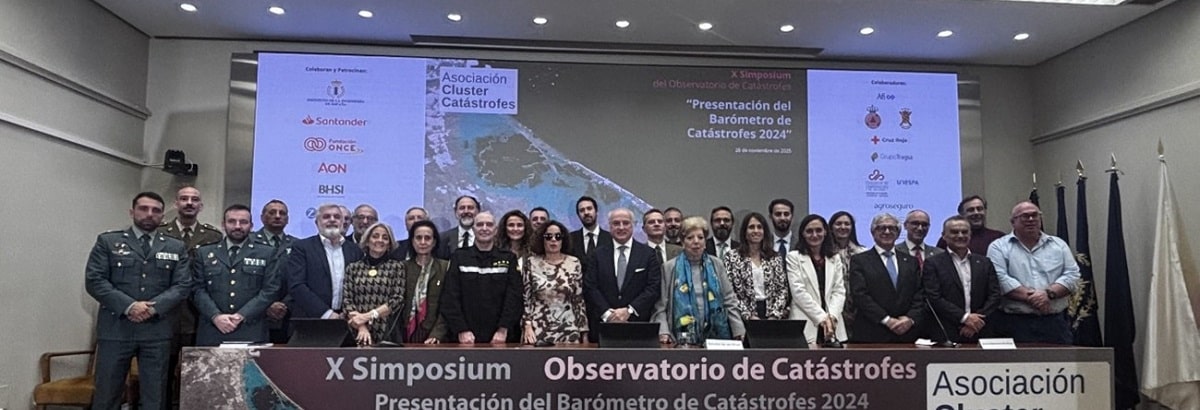
The X Symposium of the Observatory of Catastrophes brought together experts at the Spanish Institute of Engineering who analyzed this catastrophic event, the most expensive recorded in our country and one of the most disruptive in recent history. The 2024 Catastrophes Barometer was presented, a benchmark report that examines everything from emergency management to related economic and social consequences, as well as the lessons learned after the disaster.
“We can’t prevent disasters, but we can minimize the damage they inflict,” stated María Cruz Díaz Álvarez, president of the Institute of Engineering of Spain. This premise was reinforced by Pedro Tomey, founding president of the Observatory, who emphasized that extreme phenomena “occur with a regularity and a force that we would have considered exceptional years ago.”
A bruising impact
In the Community of Valencia, the epicenter of the floods, October 29 marked a turning point with devastating socio-economic effects. The labor market in the affected regions came to an almost total standstill at first. However, thanks to the institutional response and the action of leading insurance players, employment didn’t suffer massive destruction and an effective though uneven recovery was initiated. The most affected municipalities recorded year-on-year growth of 6.1% in August 2025, driven by reconstruction-related activity, while the unaffected areas maintained a rhythm similar to previous years.
The loss of human life was the most heartbreaking aspect: Victoria de Elizargarate, doctor in Economics and Business, noted that in 2024, 270 people died due to natural disasters, the highest figure of the 21st century, of which 239 (89%) were victims of Valencia floods. The expert emphasized the need to establish inclusive emergency plans, with special attention paid to people with disabilities or reduced mobility, a group that suffered disproportionately from the effects of the disaster.
Cultural fragility and operational fragility of the territory
All the speakers agreed that communication and assistance to the victims was a priority, but they also highlighted the profound impact of property damage on the lives of people. The loss of cultural property, housing, equipment or infrastructure directly affects the well-being of the communities.
One of the most innovative contributions of the 2024 Barometer was an analysis of the impact on cultural and historical assets. The storm affected 564 items of cultural interest and local relevance, most of them in the ground zero area, especially churches, chapels, and ethnographic heritage. Evaluating the status of these assets falls to the Ministry of Culture, as they constitute the collective memory and contribute to social resilience when restored. To prevent future damage, the report recommends developing emergency plans for historical heritage and digitizing files, given that water or fire damage can destroy an incalculable legacy.
During her speech, Leire Labaka, a professor at the university of Navarra, addressed the vulnerability of critical infrastructure in the face of an event of this magnitude, and delved into the impact on sectors such as energy, water, transport, and telecommunications, with a total cost of more than 1.84 billion euros. Hydraulic infrastructure was the most affected (1.3 billion euros), and the isolation left 180,000 users without power for days, in addition to interrupting more than 500,000 telecommunications lines. Labaka concluded that the damage caused revealed the urgent need to modernize and strengthen these infrastructures.
To conclude the barometer analysis. Víctor Pérez, president of FOTUR (Federation of Leisure, Tourism, Gaming, Recreational Activities and Related Industries of the Valencian Community) spoke about the social impact, which was conditioned by previous inequalities. He asked what attributes of society moderated the impact of the disaster, and suggested that a dual pattern existed – dynamic coastal and metropolitan areas and an aging interior with lower-income, which was also less responsive to change. The barometer concluded that vulnerability levels are a function not only of the magnitude of the disaster but also of pre-existing inequalities, which is why it called for territorial planning and risk management to explicitly incorporate the social component.
Insurance management: an unprecedented operation
The round table featuring Celedonio Villamayor (Spain’s Insurance Compensation Consortium), Santiago Duro (Agroseguro), and Manuel Mascaraque (UNESPA, the Spanish association of insurers and reinsurers) shed light on the magnitude of the effort of the insurance industry in the face of the greatest catastrophe in recent history. Villamayor highlighted an extraordinary operation in human resources, technical means, and coordination between insurers, with more than 4 billion euros paid out in record time. Among the lessons learned, it pointed out insufficient coverages, unexpected exclusions, and loss of earnings deficits, as well as policies not prepared for total or high-intensity losses.
Santiago Duro, director of Benefits at Agroseguro, recalled that his company is used to managing catastrophic damage, but the scale of the Valencia tragedy was unique, with more than 10,000 farmers and livestock farmers affected. He identified three lessons learned: the need for technological support in damage assistance and assessment, the precise proximity and empathy with the insured party in times of enormous vulnerability, and the need for convenient clear processes and immediate appraisals, rigorous and coordinated with coinsurers and institutions.
Other approaches: inclusion and reconstruction
The symposium included other, transversal presentations: Lourdes González, from Fundación ONCE, the Spanish National Organization for the Blind, emphasized the importance of designing adapted environments and training the population on how to act during emergencies with people with special needs. For his part, Javier Machí, dean of the Association of Road Engineers in the Valencian Community, reviewed damage, containment problems, and the need to reinforce early warning systems and reconstruction strategies based on resilience.
The day closed with the presentation of the PERC report on the floods in Valencia and a lecture on the forest fires of 2025, whose detailed analysis we will address soon in the magazine.
In conclusion, this 10th edition of the Catastrophes Barometer redefined the management of climate risk in Spain. It tested the readiness of infrastructure, administrations, and insurance companies, and brought to light social and territorial vulnerabilities, demonstrating the insurance sector’s ability to react to extreme events.
Conclusions of the 2024 Barometer
The presentation was led by Victoria de Elizagarate, Coordinator of the Annual Catastrophe Barometer; Julio Ortega Carrillo, specialist in Applied Economics at International Financial Analysts; Leire Labaka, Professor of the Tecnun School of Engineering, University of Navarra; and Víctor Pérez Segura, Professor of the Higher Technical School of Engineering, Universidad Pontificia Comillas (ICAI-ICADE), who outlined the real scope of an extraordinary year.
The first speaker of the day, Julio Ortega, stated that the insured costs from natural disasters in Spain reached the highest figure in history (6.3 billion euros), even surpassing the sum of the previous three years. Of that amount, 83% (5.3 billion) corresponded solely to Valencia, the most expensive event ever recorded in Spain. Excluding this episode, 2024 would have been the year with the lowest insured costs since 2016.
The Insurance Compensation Consortium (CCS) assumed most of the impact, paying out just under 5.0 billion euros in compensation. Agroseguro and UNESPA paid out 53 million and 192 million, respectively. The rest of the catastrophes for the year accounted for just over one billion additional euros.
Regarding the distribution by type of event, 2024 presented a statistical anomaly: while in Spain it’s common for the weight to fall on hail or drought, that year 90% of the costs were due to flooding.
The total economic impact on goods amounted to 6.7 billion euros, equivalent to 0.43% of Spanish GDP. In the Valencian Community, the bill rose to more than 4.56% of the regional GDP.