26/12/2025
The Arctic route poses technical challenges, regulatory challenges, and insurance challenges, but offers an opportunity to streamline maritime trade and navigate geopolitical risks. We analyze the pros and cons of the journey with Inmaculada Pinel, senior Transport underwriter at MAPFRE Global Risks.
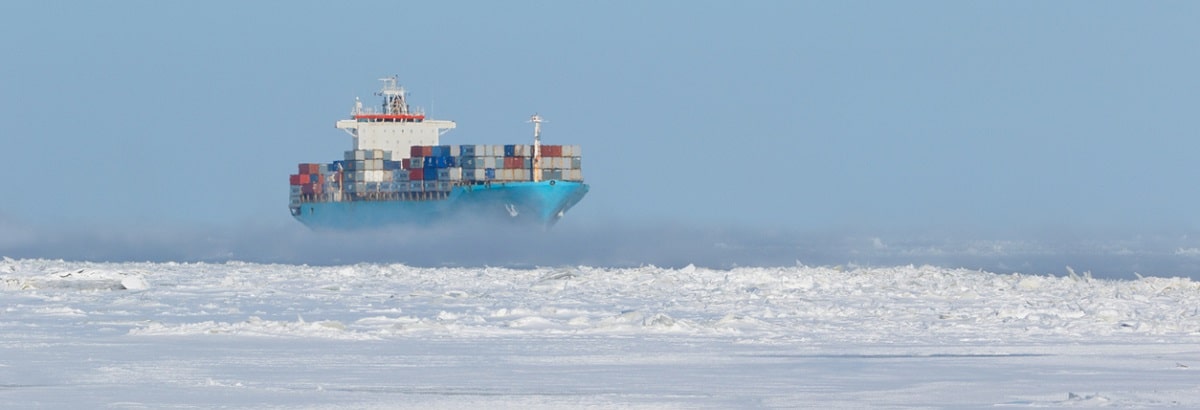
The North Sea Route (NSR, for its acronym in English) has awakened great interest in recent years as a strategic alternative to the Suez Canal, offering potential advantages in times and logistics costs, but its viability is far from being straightforward. Important challenges oppose these benefits: a high risk of navigation, strong regulatory and environmental restrictions, the need for specialized vessels and a direct impact on insurance, with higher premiums, limited coverage and more demanding conditions. We analyzed the situation together with Inmaculada Pinel, senior Transport underwriter at MAPFRE Global Risks.
The journey undoubtedly has advantages, as it not only reduces transit times between Asia and Europe by up to 15 days, but also represents a very attractive alternative for countries like China and Russia, which see it as a strategic opportunity to diversify risks and reduce dependence on conventional routes. “In a context where the attacks in the Red Sea, port congestion, and freight volatility have strained the logistics chains, having an additional broker seems attractive,” explains Pinel.
A seasonal route with strong limitations
The use of the NSR is highly conditioned by ice, the lack of infrastructure, and a highly seasonal operation, which limits its viability to certified fleets and highly specialized operators. “It is not an open route all year round:” its operability depends on the ice conditions and limited infrastructure. In winter, transit is practically unfeasible except for highly specialized vessels and under strict regulation,” says the expert, implying that only operators prepared to take high risks can aspire to access the route, and only in very specific scenarios.
These limitations are compounded by technical and regulatory requirements that are much higher than those of conventional routes. “The ships must have a combination of structural capacity, power, equipment, and specialized crew,” points out Inmaculada Pinel. Furthermore, ice-class certification is mandatory, in accordance with the standards of internationally recognized classification societies such as DNV, Lloyd’s Register, or RMRS, which significantly restricts the type of fleet suitable for the crossing.
The implications for the load are also unique. Extreme temperatures can alter the physicochemical properties of certain goods —for example, liquid crystallization or packaging fracture— in addition to the vibrations resulting from impact with ice plates and a severe shortage of safe haven ports. This context “it increases the severity of any incident and requires the design of specific coverages, such as clauses for cold-sensitive goods or contingency plans in the event of limited salvage.”
Regulation and Environmental Protection
On the regulatory and environmental front, navigation along the North Sea Route is subject to a complex overlap of international and national standards. “The Polar Code of the IMO (International Maritime Organization), in force since 2017, establishes requirements regarding ship design, operation, and specific crew training,” it warns. This is compounded by Russian regulations, as the route runs through waters under the jurisdiction of the country, which requires prior permits, approved travel plans, and, in many cases, mandatory escort by icebreakers.
All of this takes place, moreover, in an environment of high ecological sensitivity, with growing restrictions such as the partial ban on the use of heavy fuels starting in 2024 —which will be total in 2029— and reinforced control of emissions and ballast water to prevent the introduction of invasive species.
A challenge for the insurance industry
The activation of the NSR forces the maritime insurance industry to face a particularly complex context. “The opening pushes the industry towards a scenario of more severe risks, less diversified, closely interrelated, and that tend to occur together,” explains Inmaculada Pinel. This concentration of risks translates into greater technical requirements, stricter limits, and an increase in premiums.
Therefore, the insurance market is prudent and highly selective, and navigation through this route is not addressed through standard products, but rather through individual analysis. “Policies for the NSR are negotiated on a case-by-case basis; it is a risk considered exceptional that requires specific approval from the underwriter,” he emphasizes.
When the risk is accepted, the coverage must be adapted to the particularities of the environment, with Ice Navigation Endorsement policies —which prove the competition to navigate in ice conditions—, expanding the limits for salvage, including environmental clauses reinforcing and also specific exclusions for the pollution of polar zones. This is complemented by especially conservative reinsurance. “Available capacity is limited and measures are applied to control polar accumulation, which leads us to higher insurance premiums and reinsurance premiums,” he admits.
Viability and business challenges
Although there are indisputable advantages in using the North Sea Route, it can hardly become a real alternative to the large consolidated maritime corridors. “The NSR could partially consolidate, but not as a substitute for the Suez channel, rather as a seasonal and alternative corridor for certain operators and types of merchandise,” points out the expert.
Its evolution will depend on advances in infrastructure, logistics, technology, and geopolitical stability, factors that evolve slowly, and a gradual development and limited development is more likely. “It is unlikely to become a benchmark global corridor in the coming decades, although it may occupy a place of relevance as a seasonal route for specific goods and fleets prepared for ice,” he concludes.
Author of the text:

Inmaculada Pinel
Transport Senior Underwriter at Mapfre Global Risks