20/02/2026
In a moment of profound transformation for the naval and energy industry, Navantia has strengthened its risk management model with the appointment of Valentín Trijueque as the Global Head of Insurance and Alternative Risk Transfer. His arrival marks a decisive boost toward a more strategic, digital, and global focus in insurance management. Trijueque takes on the challenge of consolidating a corporate model that combines anticipation, professionalization, and intensive data use in an environment where regulatory, technological, and geopolitical volatility demand faster and more rigorous responses than ever.
At Mapfre Global Risks, we wanted to talk to him about the future of one of the most relevant industrial companies in Spain.
Navantia carries out highly complex and high-risk industrial projects, such as shipbuilding and large offshore wind energy solutions, which involve financial, operational, and even reputational risks. Effective risk management is crucial to ensure the delivery of projects within the budget, by the established deadlines, and with the required quality standards. What are the main strategies that Navantia uses to manage risks in its industrial projects?
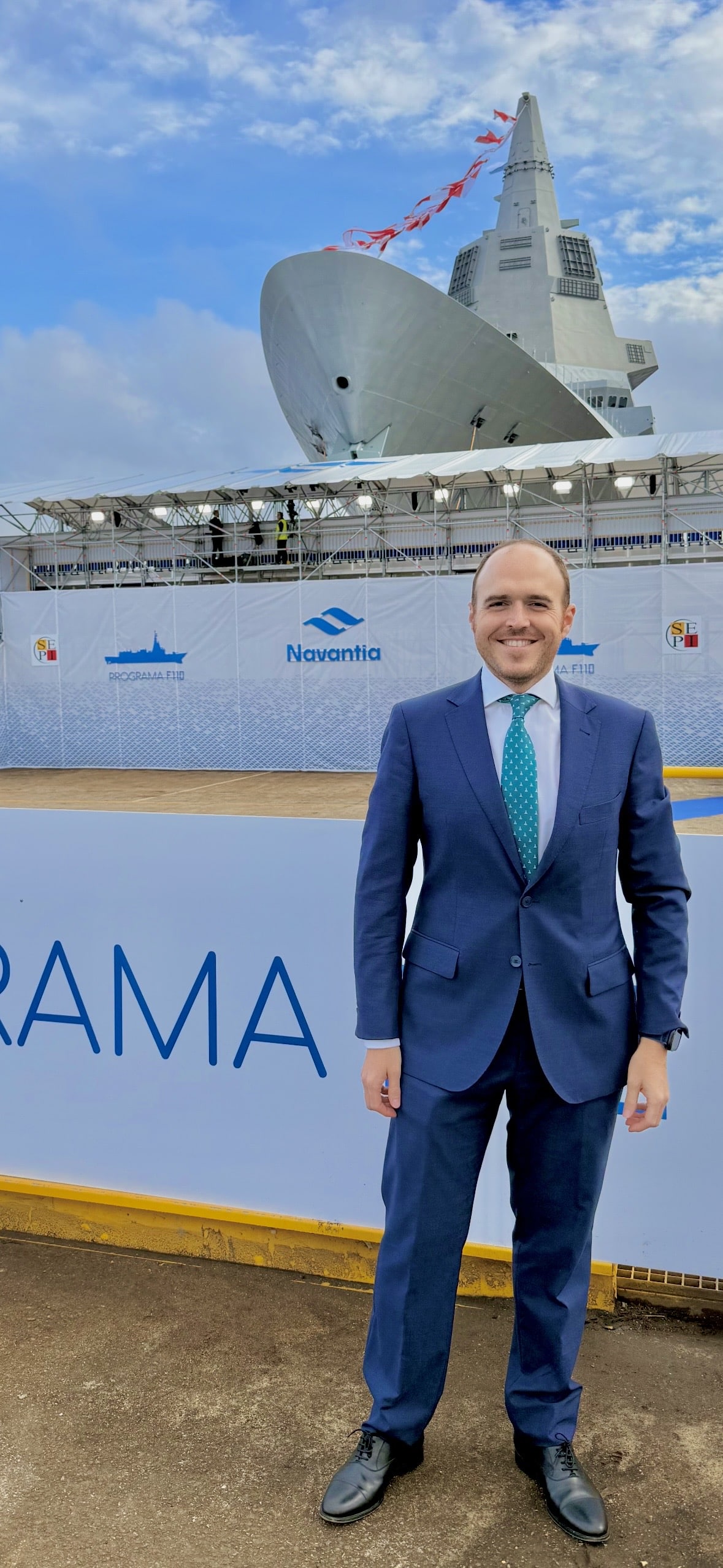 At Navantia, each project is a genuine voyage through complexity. Whether we are talking about a next-generation submarine or an offshore wind platform, they all share a common denominator: technical, contractual, and operational challenges. To manage them, we have built a comprehensive risk management model that acts as the backbone of the entire organization, combining methodology, corporate culture, and centralized supervision.
Moreover, at the heart of Navantia’s governance model lies a fully proactive approach: we do not wait for threats to emerge—we seek them out, analyze them, and determine how to address them before they impact our programs. It is a meticulous process that we apply uniformly throughout the company: early identification, qualitative and quantitative analysis, response plans, and continuous monitoring with indicators that function as advanced risk sensors.
“At Navantia, each project is a genuine voyage through complexity”
At the corporate level, we maintain a Risk Catalog that classifies strategic, operational, regulatory, financial, and reputational threats. Its periodic review ensures that our exposure map remains continuously updated and that we can make decisions with the agility required in a constantly evolving sector. At the same time, each program—each boat, each system, each physical asset—develops its own Risk Management Plan, tailored to its technical and contractual complexity. This enables engineering, production, supply chains, and testing teams to operate under a single roadmap, sharing a clear understanding of critical risks and the necessary mitigation measures.
What are the main challenges currently facing the industrial insurance sector and how is Navantia addressing them?
Industrial insurance is going through a period of significant pressure: a soft market for traditional lines, growing climate-related risks, and a geopolitical environment that makes any forecasting increasingly complex. Added to this strain is technological pressure—cyberattacks, automation, artificial intelligence—which is completely redefining how risks are assessed and underwritten on a global scale.
In this scenario, at Navantia we have reinforced our insurance protection with a very clear strategy: centralizing, professionalizing, and anticipating.
The International Corporate Insurance Program allows us to expand markets, adjust coverage, and negotiate in bulk. This approach that has been especially decisive following the incorporation of new subsidiaries such as Navantia UK.
Emerging technologies, such as artificial intelligence, are transforming the way industrial companies assess and manage risks, including the insurance sector. The use of these technologies could improve risk modeling, optimize claims processing, or reduce insurance premiums through real-time data. In your particular case, how is technology influencing industrial insurance management at Navantia?
Technology is also a fundamental pillar: today we work with advanced data analytics, exposure modeling, and tools that allow us to respond with greater agility in an increasingly demanding sector. In addition, we are moving toward innovative risk transfer solutions and a globally oriented insurance model. Ultimately, we are transforming the way we manage risk in order to respond to a market undergoing profound change.
Today we use advanced analytics, artificial intelligence, and digital platforms that enhance risk modeling, optimize processes, and help us make decisions.
“We are moving toward innovative risk transfer solutions and a globally oriented insurance model”
This transformation is clearly seen in the International Corporate Insurance Program that I mentioned earlier. The integration of new areas, such as Navantia UK, requires us to manage large volumes of technical, operational, and economic information. Digitalization makes it easier to consolidate that data, compare it, and update scenarios in real time.
Another key aspect is data governance and automation. We have developed an internal insurance application together with a technology partner that allows us to manage policies, claims, and exposures in a centralized manner, which is essential for an organization with our complexity. Thanks to this, we are evolving toward a predictive, integrated, and global model, where data is at the core of decision-making. This evolution not only improves our internal efficiency but also strengthens our position against an increasingly demanding insurance sector in terms of precision, transparency, and ability to anticipate.
In terms of sustainability, how does Navantia integrate the sustainability principles into its industrial insurance management?
For us, sustainability is not another add-on: it is a criterion that already determines how we assess risks and how we structure the coverages of our industrial insurance solutions. We start from a solid ESG framework, reflected in our 2024 Sustainability Report, where we confirm a 41.17% reduction in carbon footprint, the certification of ‘zero waste’ at all centers, and environmental management aligned with multi-site ISO 14001 standards.
This performance not only reinforces our reputation, but also directly influences how we are perceived by insurance companies. Initiatives such as the Navantia Ecosystem project, focused on offsetting emissions and supporting biodiversity, consolidate that image of a responsible company and with lower environmental exposure, something we hope will have an increasing impact on the negotiations of the International Corporate Insurance Program.
Could you share any recent success stories and the lessons learned that have improved the insurance management practices at Navantia?
One of our most recent success stories has been the integration of Navantia UK within the International Corporate Insurance Program. The acquisition of the assets of Harland & Wolff forced us to adapt our risk map in record time, incorporating new shipyards and very different exposures. We successfully integrated the majority of these risks into the PISC renewal cycle without losing capacity or continuity—an achievement made possible only through flawless coordination between technical, financial, and insurance teams, including Mapfre. This experience left us with three key takeaways: the importance of data to present an accurate risk image, the value of truly centralized management, and the need to anticipate future insurance needs in increasingly complex environments.
What have been the most significant challenges you’ve faced since taking on your role, and what has assuming these responsibilities meant for you personally?
 Since my arrival in office, the greatest challenge has been to assume global responsibility in an environment that continues to transform. Industrial insurance is experiencing a period of tremendous pressure—with more sophisticated risks, more selective markets, and higher technical demands—which has forced us from day one to strengthen our anticipation and analytical capabilities. We have had to integrate new risk perimeters, modernize processes, standardize criteria, and above all, further professionalize management to operate with a corporate vision and not a fragmented one.
“We are focused on fostering a culture of continuous learning, collaboration, and responsible autonomy”
Currently, my greatest professional challenge is the development of a high-performance insurance team within the Navantia Group. We have a young team with a lot of potential, so I am focusing on promoting their growth, consolidating strong technical knowledge, and directing our capabilities toward providing strategic value and excellent service to both internal and external customers. We are focused on fostering a culture of continuous learning, collaboration, and responsible autonomy. This evolution has allowed us to position ourselves as a strategic partner for the business and not just as a support area.
Likewise, I want to highlight the support we are receiving from the company, which has recognized the importance of strengthening the Directorate of Insurance and Alternative Risk Treatments internally. This strategic alignment facilitates driving change, mobilizing resources, and reducing external dependencies, preparing us to face current and future challenges with strength.
On a personal level, it has represented a jump in intensity and commitment. Managing insurance programs of this magnitude implies making quick decisions, based on reliable data and with a direct impact on the operational continuity of the company. But it has also represented an exceptional opportunity to drive real transformation: from the digitalization of the PISC, to strengthening data governance, and consolidating a more strategic, global insurance model that is better aligned with Navantia’s present and future challenges.
It is an enormous challenge, but also a privilege, allowing me to contribute to Navantia’s progress toward a more modern, robust risk transfer model—one prepared for an environment that demands faster, more technical, and more efficient decision-making than ever. Every day, we help build a piece of Spain.
How would you describe the relationship with Mapfre Global Risks and what about it stands out to you?
At Navantia, we work with highly specialized risks that are critical to national defense. To manage them effectively, we need insurers, brokers, and technology providers who bring technical expertise, international capabilities, and access to data and solutions that could not be developed in isolation. At the same time, Navantia is a public company that depends on the Ministry of Finance and whose main client is the Ministry of Defense, so our main focus is to compete to try to obtain the best coverage at the best premium to optimize the state’s resources.
As is logical, two Spanish multinationals like Navantia and Mapfre will always seek the greatest benefit for our country. In this sense, we can qualify the relationship with Mapfre Global Risks and with Mapfre in general as strategic. Together, we manage complex risks—many of them unique in the market due to their naval, industrial, and technological nature—and we need a partner who understands this complexity and can respond with precision, reliability, and flexibility.
I would highlight its ability to accompany us in processes that require a comprehensive view of risk: from technical modeling to the adaptation of coverage for highly specialized projects. We also value its high availability and practical approach; we can sit down together, analyze scenarios, and build tailored solutions—something essential in a context of increasing volatility and exposure. This proximity, combined with its technical knowledge and global capacity, makes Mapfre an insurance partner that provides certainty and helps us maintain the level of excellence required by the Navantia programs.
Navantia operates in a highly regulated industry, subject to both local Spanish laws and international standards, such as those of the European Union or maritime organizations. How do regulations such as the EU’s Corporate Sustainability Reporting Directive (CSRD) or climate risk disclosure standards shape industrial insurance management at Navantia?
Local and international regulations have a direct impact on how we manage industrial insurance at Navantia. We operate in a highly regulated industry with very demanding standards—from Spanish regulations to European frameworks such as the CSRD or climate risk disclosure obligations—and this requires us to work with absolute traceability of risk, transparency in information, and constant alignment between our internal practices and what the regulator requires.
In parallel, maritime and defense sector regulations impose operational and technical requirements that also influence the transfer of risk: liability limits, safety protocols, environmental standards, or certification requirements. All of this creates an environment where it is not enough to simply manage insurance; it must be managed in alignment with a constantly evolving regulatory framework.
In any case, these regulations are not an obstacle: they are an engine that drives us to be more rigorous, transparent, and solid in our performance.
Author of text:

Gonzalo Sanz Segovia
Communication Advisor